What does sleep actually do for recovery?
Sleep is regularly presented as the moment when “the muscle repairs itself”. The phrase is convenient, but it mixes solid facts, partial observations and hypotheses still being explored. The distinction is worth making, because it changes what can legitimately be concluded from it.
The central question of this page is therefore: what is really documented about sleep and recovery, and from what point do we move on to explanations that are still hypothetical?
Key point
The answer in three sentences
What is best documented concerns performance and the perception of effort: a lack of sleep degrades prolonged efforts, mood and cognitive function fairly consistently, whereas the effects on brief maximal strength are more mixed.
The hormonal and molecular explanations linking sleep loss to poorer muscle recovery were put forward as a hypothesis and do not carry the same evidential status. Recognising that difference is the main contribution of this page.
What a night of sleep is
A night is not a uniform state. It is made up of successive cycles, in which phases of non-REM sleep of varying depth alternate with phases of REM sleep, associated with dreaming. The proportion of each phase changes over the course of the night.
Slow-wave sleep
The phase of sleep hardest to interrupt, characterised by slow, high-amplitude brain activity. It is concentrated in the first part of the night and decreases across the successive cycles.
deep non-REM sleep
Sleep debt
The accumulated gap between the sleep obtained and the sleep a person would need. It most often builds up through repeated, moderate restrictions, which are more common than a full night without sleep, and it is this partial form that protocols increasingly study.
sleep restriction
Timeline of a night
A night, cycle by cycle
- 1Falling asleepStart of the nightGradual passage from light sleep to slow-wave sleep, over a few tens of minutes.
- 2First cyclesFirst part of the nightSlow-wave sleep takes up the largest share; this is the portion hardest to interrupt.
- 3Intermediate cyclesMiddle of the nightThe cycles follow one another and the share of REM sleep increases progressively with each turn.
- 4Last cyclesEnd of the nightREM sleep dominates while slow-wave sleep has become rare.
- 5WakingMorningComing out of sleep is more or less abrupt depending on the phase that is interrupted.
- 6Shortened nightVariantCutting a night short mainly removes its end, and therefore the period richest in REM sleep, rather than reducing each phase proportionally.
Sleep and recovery
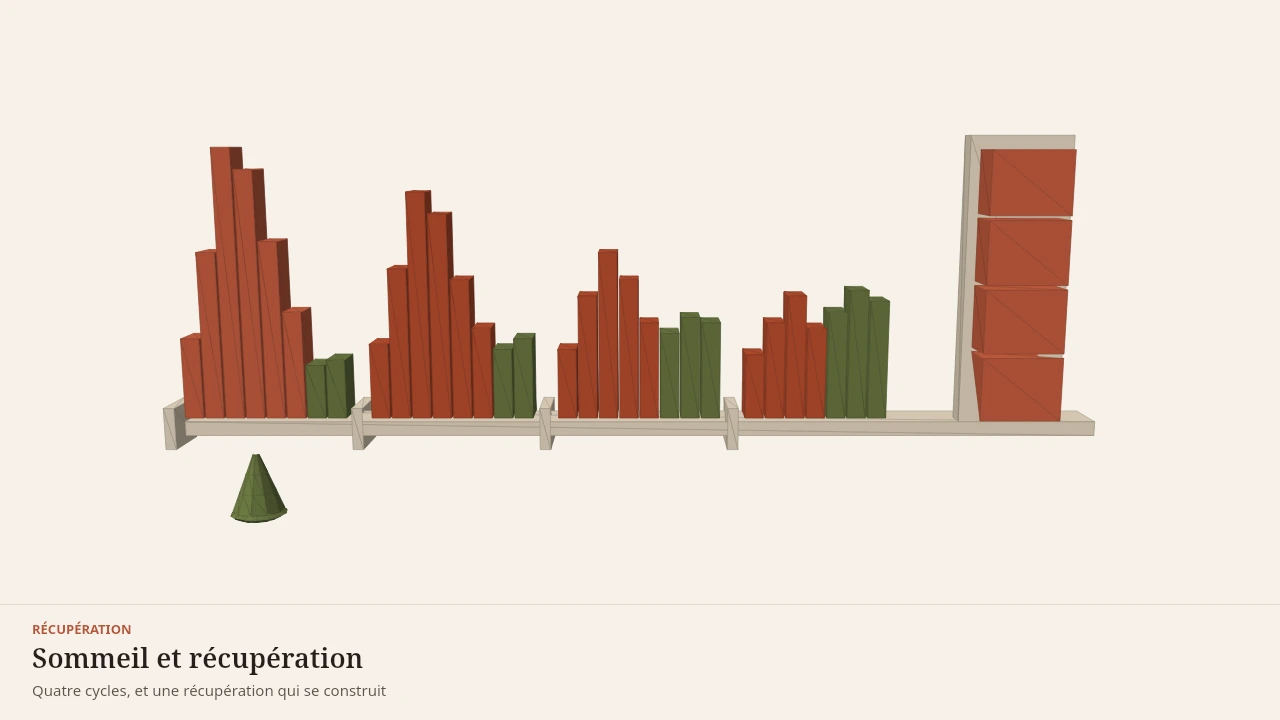
The scene runs through the alternation of phases across a night and shows how a shortened night changes its composition. The text above describes the same stages without the visualisation.
Current step
1. The night is made of cycles
The horizontal axis stands for one night, from falling asleep to waking. It is not uniform: it runs as a series of cycles, drawn here as four groups of blocks separated by tick marks.
Scene description
Bar diagram sitting on a horizontal axis that represents one night, from falling asleep on the left to waking on the right. Four groups of blocks, separated by tick marks, stand for four sleep cycles: within each group, dark blocks rise and then fall — slow-wave sleep, deepest in the middle of the cycle — and end with olive blocks standing for REM sleep. The dark blocks are markedly taller in the first cycle and get lower from cycle to cycle, while the olive blocks become more numerous and taller toward the end of the night. On the right, a framed column fills with four stacked blocks, one per completed cycle: this is accumulated recovery. A cone-shaped marker below the axis points at the current cycle and moves from cycle to cycle. The heights are qualitative and the spacing is even: no duration is measured here.
Visible structures
- Sleep cycleA night runs as a series of cycles. Each one descends into deep slow-wave sleep, comes back up, and ends with a phase of REM sleep.
- Deep slow-wave sleepThe tallest blocks stand for deep slow-wave sleep, concentrated in the early part of the night. It is the portion most closely associated with physical recovery.
- REM sleepThe olive blocks at the end of each cycle stand for REM sleep. Its share grows across the night: it is the portion an early awakening cuts into most.
- Accumulated recoveryThe column gains one block per completed cycle. It is a reminder that recovery accumulates across the night and cannot be made up all at once.
- Axis of the nightThe axis reads left to right, from falling asleep to waking. The tick marks separate the cycles; their even spacing is a reading convenience, not a measured duration.
Guided steps
- 1/5The horizontal axis stands for one night, from falling asleep to waking. It is not uniform: it runs as a series of cycles, drawn here as four groups of blocks separated by tick marks.
- 2/5In the first cycles the dark blocks rise high: this is deep slow-wave sleep. Its share is largest early in the night, then shrinks cycle after cycle.
- 3/5The olive blocks that close each cycle stand for REM sleep. Their number and height increase toward morning: the make-up of the night changes from start to finish.
- 4/5On the right, the column gains one block per completed cycle. Recovery is not a switch: it is built up by successive additions across the whole night.
- 5/5A night cut short mainly removes the final cycles, the ones where REM sleep is most present, and leaves the column incomplete. The cycles lost are not the same as those at the start.
Model licence · Shapier — Propriétaire — usage interne ShapierLab
Certainty level · Teaching simplification
Saying that “the muscle repairs itself during sleep” is a simplification.
The turnover of muscle proteins continues at all times, day and night, and no phase of sleep has been identified as the exclusive moment of muscle repair. The description of sleep architecture used here comes in part from a popular science book, useful for situating the phases but which does not have the status of a primary source and some of whose formulations have been debated.
Walker MP (2017)
What a lack of sleep changes
Reported effects of sleep deprivation
Domain
Reported effect
Consistency of results
Perception of effort
Effort felt as harder at the same load
Fairly consistent
Prolonged or repeated efforts
Degraded performance
Fairly consistent
Maximal strength in a brief effort
Contradictory results across protocols
Heterogeneous
Mood and cognitive function
Clear deterioration, notably of alertness
Fairly consistent
Muscle recovery and hormones
Assumed impairment
Hypothesis, not demonstrated
Certainty level · Probable
Sleep deprivation degrades some aspects of exercise performance, but not all of them in the same way.
The review reports fairly consistent effects on prolonged or repeated efforts, on the perception of effort and on cognitive function, whereas the results concerning maximal strength produced in a brief effort are contradictory. Protocols vary considerably between studies, which limits the reach of any general conclusion and explains part of the divergence.
Fullagar HHK, Skorski S, Duffield R, Hammes D, Coutts AJ, Meyer T (2015)
Certainty level · Uncertain
The hormonal and molecular explanation of the link between sleep and muscle recovery remains a hypothesis.
The reference article on this point is explicitly presented by its authors as a proposal, connecting hormonal changes with increased protein breakdown. It brings together indirect elements and opens a line of research; it does not demonstrate the causal chain it describes, and presenting it as an established fact would be an extrapolation.
Dattilo M, Antunes HKM, Medeiros A, et al. (2011)
How much sleep, and for whom?
Certainty level · Established
The reference figures for adult sleep duration come from an expert consensus whose method is published.
The panel reviewed the available literature and then established by vote a recommended range of seven to nine hours per night for adults, with different ranges by age group. This is a recommendation aimed at populations, accompanied by its authors with an allowance for individual variation; it does not constitute a prescription and does not replace a personalised assessment.
Hirshkowitz M, Whiton K, Albert SM, et al. (2015)
This distinction matters. A population range indicates where the majority of observed needs sit; it does not say what any given person needs, and a duration within the range does not guarantee good-quality sleep.
What this implies in practice
Three general consequences emerge. Regular sleep conditions the ability to repeat sessions, which makes it an indirect but real determinant of adaptation, since adaptation depends on the accumulation of sessions over weeks. A session that feels abnormally hard after a short night is partly explained by the perception of effort, without a drop in capacity necessarily being present. And the absence of solid evidence about hormonal mechanisms justifies neither ignoring sleep nor turning it into a universal explanation.
No duration, no schedule and no routine are recommended here. Sleep needs vary with age, health status, work rhythm and many individual factors.
Certainty level · Probable
Sleep acts on adaptation mainly through the continuity of training that it makes possible.
Muscular adaptation results from the accumulation of sessions over several weeks; anything that reduces the ability to train regularly mechanically reduces that accumulation. This reasoning rests on results that are solid taken separately, but the direct link between sleep duration and measured muscle gains has not been the subject of long-term controlled trials.
Fullagar HHK, Skorski S, Duffield R, Hammes D, Coutts AJ, Meyer T (2015) · Damas F, Phillips SM, Vechin FC, Ugrinowitsch C (2015)
Limits, and situations that call for professional advice
Sleep deprivation protocols are heterogeneous, often short, and carried out in small samples. The association observed between sleep loss and reduced performance does not on its own demonstrate a mechanism, and the hormonal explanations put forward are today a matter of hypothesis.
Caution
When to seek professional advice
This page describes a general physiological mechanism. It diagnoses no sleep disorder and proposes no management.
Medical advice is appropriate in case of substantial daytime sleepiness, falling asleep involuntarily, snoring with breathing pauses reported by those around you, insomnia that lasts, persistent fatigue despite sufficient nights, or when an ongoing treatment disturbs sleep. These situations are matters for specialist assessment, not for adjusting training.
Key sources
- Hirshkowitz M, Whiton K, Albert SM, et al. (2015). National Sleep Foundation's sleep time duration recommendations: methodology and results summary. Sleep Health.DOI : 10.1016/j.sleh.2014.12.010
- Fullagar HHK, Skorski S, Duffield R, Hammes D, Coutts AJ, Meyer T (2015). Sleep and athletic performance: the effects of sleep loss on exercise performance, and physiological and cognitive responses to exercise. Sports Medicine.DOI : 10.1007/s40279-014-0260-0
- Dattilo M, Antunes HKM, Medeiros A, et al. (2011). Sleep and muscle recovery: endocrinological and molecular basis for a new and promising hypothesis. Medical Hypotheses.DOI : 10.1016/j.mehy.2011.04.017
- Walker MP (2017). Why We Sleep: Unlocking the Power of Sleep and Dreams. Scribner.https://www.simonandschuster.com/books/Why-We-Sleep/Matthew-Walker/9781501144318
- Damas F, Phillips SM, Vechin FC, Ugrinowitsch C (2015). A review of resistance training-induced changes in skeletal muscle protein synthesis and their contribution to hypertrophy. Sports Medicine.DOI : 10.1007/s40279-015-0320-0
Put it into practice in Shapier
Plan your sessions and rest days
Spreading sessions and rest days across the week is done in Shapier; Body Lab only explains why that distribution matters.
Plan your sessions and rest days
Body Lab explains; Shapier lets you act and track.
Read next
- Muscle protein synthesisWhat happens when muscle manufactures proteins, and is that manufacture enough to predict growth? This page describes the response to exercise and to food, and explains why a single snapshot measurement is so often misleading.With a 3D scene
- How muscle growsWhat actually makes a muscle grow? This page follows the chain of events that links a set of exercise to a thicker muscle fibre, and separates what is established from what is still debated by research.With a 3D scene
- Muscle glycogen and waterWhy can the number on the scales change within two days without any change in fat mass? This page explains what muscle glycogen is, its role as a fuel and the water that accompanies it inside the muscle.With a 3D scene
- Sleep and recovery — the videoAn animation that runs through a night of sleep cycle by cycle, then shows what a shortage of sleep changes in physical performance and alertness. The page carries the same content in text, with its sources and the limits of the measurements.With a 3D scene
Check my understanding
What is the status of the hormonal explanation linking sleep loss to poorer muscle recovery?
A hypothesis published as such, not a demonstration
A mechanism demonstrated by controlled trials
An idea abandoned by research
What happens to the composition of a night when it is cut short?
The end of the night is removed, and therefore mainly REM sleep
Each phase is reduced in the same proportion
Only slow-wave sleep disappears
Choose an answer
Available offline
Offline download is available in the mobile app.
Trust and method
Author
Editorial review
Thanh Chau
Published on
August 2, 2026
Reviewed on August 2, 2026
Next review due August 2, 2027
Limits of this page
- Sleep deprivation studies use highly heterogeneous protocols (a full night without sleep, partial restriction, early or late awakening), which makes their results hard to compare with one another.
- The link between sleep and muscle recovery rests in part on a hypothesis put forward in a proposal article, not on an experimental demonstration.
- The duration guidance cited comes from an expert consensus applied to general populations, and not from a controlled trial comparing sleep durations.
- This page covers neither sleep disorders nor their management, which are matters for medical assessment.
Educational content. Body Lab does not diagnose and does not replace professional advice.
How we work