Why does body weight change with no change in fat mass?
Key point
The answer in three sentences
Muscle stores carbohydrate in a branched form called glycogen, which is a major fuel as soon as the intensity of an effort increases.
That storage is not dry: glycogen is accompanied by water inside the fibre. Emptying and then refilling these stores therefore makes body mass change quickly, whereas fat mass changes only very slowly.
Two days are sometimes enough for the scales to show several hundred grams of difference, one way or the other, when no change in fat mass is physiologically possible over such a short period. These movements have several causes, but one of them is directly linked to the way muscle stores its fuel.
The central question of this page is therefore: why does the carbohydrate store of muscle make body weight change, and what does that tell us about body composition?
What is glycogen and where is it stored?
Glycogen
The form in which the body stores glucose. It is a heavily branched molecule, found mainly in the muscles and in the liver. Muscle glycogen fuels the muscle in which it is stored; liver glycogen serves mainly to maintain the concentration of glucose in the blood.
carbohydrate store · glycogen stores
This distinction has an important practical consequence. Glycogen stored in a muscle cannot be shared: it fuels the fibres that contain it. A session that heavily taxes the legs mainly reduces the stores of the muscles concerned, without emptying the whole body in the same way.
Certainty level · Established
Muscle glycogen is a major fuel for efforts of moderate to high intensity, and its availability is associated with the ability to sustain that intensity.
This relationship is described consistently by review articles, on the basis of biopsies and of protocols manipulating carbohydrate intake. It is particularly well documented for prolonged endurance efforts; for resistance training, the data are fewer and less clear-cut.
Burke LM, Hawley JA, Wong SHS, Jeukendrup AE (2011) · Baker JS, McCormick MC, Robergs RA (2010)
How much water accompanies stored glycogen?
Glycogen is not stored dry in the muscle fibre. It holds water, and it is this water that accounts for most of the rapid weight changes observed after a long session, after a day of eating again, or in the first days of a change of diet.
Glycogen resynthesis
Process by which muscle rebuilds its glycogen stores after an effort that has reduced them. Its speed depends notably on how far they fell and on carbohydrate intake; muscle water changes alongside it.
restoring the stores
Certainty level · Probable
The water contained in muscle increases alongside the rebuilding of glycogen.
The study cited measured, in humans, the joint recovery of glycogen and muscle water after prolonged exercise carried out in the heat; the relationship observed is compatible with the order of magnitude classically accepted, close to three grams of water per gram of glycogen. This is a single piece of work, conducted in a small sample and under particular conditions, which rules out treating it as a universal constant.
Fernández-Elías VE, Ortega JF, Nelson RK, Mora-Rodriguez R (2015)
Certainty level · Uncertain
The exact share of a weight change attributable to glycogen and its water is not established.
The available measurements concern muscle sampled or observed by imaging, not total body weight, which varies simultaneously for other reasons: extracellular water, digestive contents, sodium intake, hormonal cycle. Going from a relationship measured in the tissue to a number displayed by a set of scales requires a chain of assumptions that the work cited does not test.
Burke LM, Hawley JA, Wong SHS, Jeukendrup AE (2011) · Fernández-Elías VE, Ortega JF, Nelson RK, Mora-Rodriguez R (2015)
Timeline of a long session and of recovery
From full stores to restored stores
- 1Before the effortStartThe glycogen stores of the muscles and the liver are at their usual level, with the water that accompanies them.
- 2Prolonged effortTens of minutes to hoursThe glycogen of the muscles being used is broken down to fuel contraction; the share it represents increases with intensity.
- 3Reduced storesEnd of the sessionThe local store has fallen markedly, which is associated with growing difficulty in maintaining the starting intensity.
- 4Carbohydrate intakeThe following hoursRebuilding begins. Its speed depends on how far the stores fell and on dietary intake.
- 5Water comes backHours to daysMuscle water rises alongside glycogen, which pushes the displayed weight back up with no change in fat mass.
- 6Stores restoredOne to several daysThe return to the initial level depends on diet and on the training load of the following days.
Storing and using glycogen
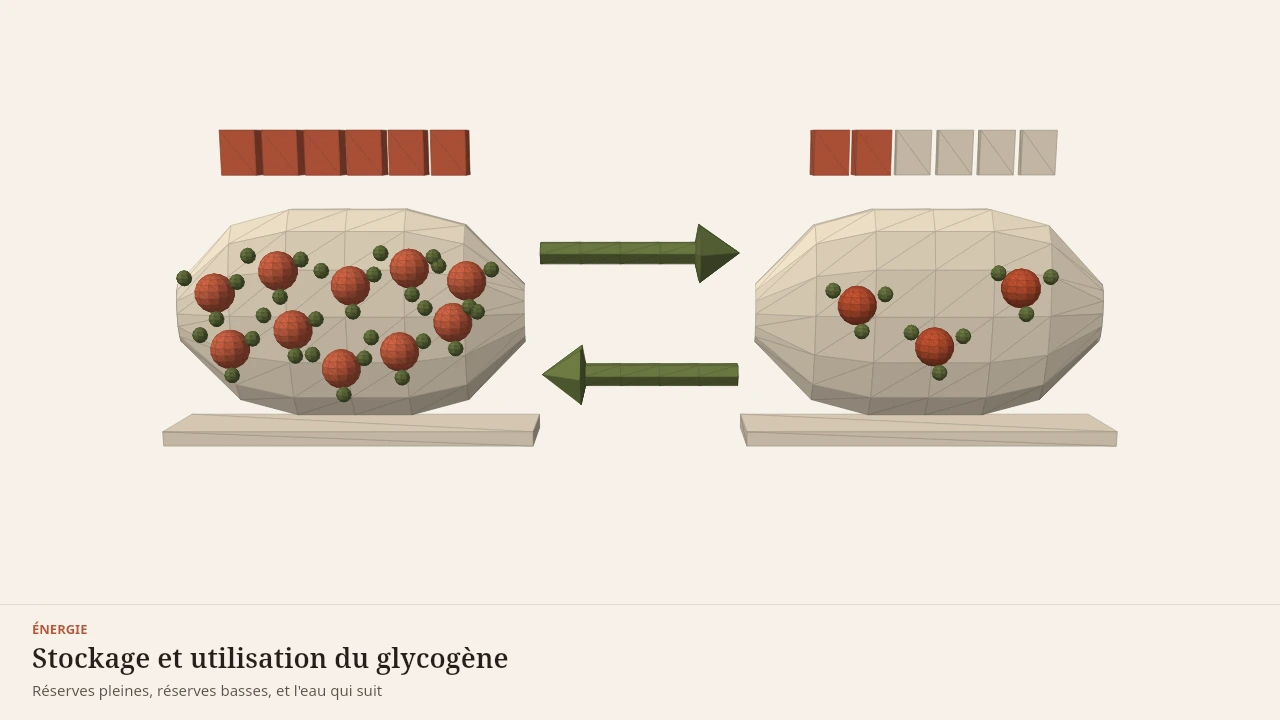
The scene represents the filling and emptying of glycogen stores in a muscle fibre, together with the water that accompanies them. The same stages are described in the timeline above.
Current step
1. The store inside the fibre
On the left, a muscle fibre opened along its length. The dark spheres spread inside stand for glycogen granules, the form in which muscle stores carbohydrate.
Scene description
Comparative diagram: two identical muscle fibres, opened lengthwise like slices, sit side by side on pale plinths. The left one, with full stores, holds about ten dark spheres — the glycogen granules — each ringed by three small spheres standing for the water stored with it; above it, a six-segment gauge is completely filled. The right one, with low stores, holds only three granules and their water, and its gauge shows just two solid segments followed by four hollow ones. Between the two fibres, an upper arrow pointing right represents the effort that empties the store, and a lower arrow pointing left represents the dietary refuelling that rebuilds it. Sizes and counts are symbolic: nothing here is to scale.
Visible structures
- Glycogen granuleGlycogen is the form in which muscle stores carbohydrate. It is gathered into granules spread through the fibre, ready to be mobilised quickly during effort.
- Associated waterGlycogen is stored together with water, shown here as the small satellite spheres. When the store falls, that water leaves with it and the number on the scale follows, which says nothing about fat mass.
- Fibre in sectionThe fibre is drawn as a slice, as if it had been opened along its length. The section only serves to show what it contains.
- Low storesAfter a long effort, few granules are left. The fibre still works, but the intensity it can sustain drops.
- RefuellingDietary carbohydrate rebuilds glycogen, and the associated water comes back with it. This is one of the reasons the number on the scale moves from one day to the next.
Guided steps
- 1/5On the left, a muscle fibre opened along its length. The dark spheres spread inside stand for glycogen granules, the form in which muscle stores carbohydrate.
- 2/5Each granule is ringed by small spheres: the water stored alongside it. Glycogen and water travel together, which explains part of the day-to-day swings on the scale.
- 3/5During sustained effort the fibre breaks down its glycogen to produce energy. The upper arrow shows the move from one state to the other, and the group of granules shrinks.
- 4/5On the right, the same fibre after the effort: few granules, little associated water, an almost empty gauge. The number on the scale has dropped, but that particular drop comes from glycogen and its water, not from fat mass.
- 5/5Dietary carbohydrate rebuilds the store and the water returns with it: the lower arrow brings the fibre back to its full state. This back-and-forth repeats continuously, independently of fat mass.
Model licence · Shapier — Propriétaire — usage interne ShapierLab
What influences glycogen replenishment?
What the muscle stores and what the scales show
Situation
What changes in the muscle
What the scales show
Long, intense session
Glycogen reduced, associated water lowered
Weight down, with no equivalent loss of fat mass
Carbohydrate intake resumed
Glycogen and water restored
Weight up quickly, often within a day or two
Lasting reduction in carbohydrate
Stores held at a lower level
Weight stabilised lower, independently of fat mass
Several factors modulate the speed of rebuilding: how far the stores initially fell, carbohydrate intake in the hours that follow, the repetition of sessions and the interval between them, as well as the type of carbohydrate ingested.
Certainty level · Probable
Combining several types of carbohydrate allows a higher rate of use than a single carbohydrate during effort.
The limit comes not from the muscle but from intestinal transport, which saturates for a given type of carbohydrate; recruiting several transport routes partly lifts that limit. This result concerns the use of carbohydrate during prolonged endurance efforts and does not transfer directly to the speed at which stores are rebuilt at rest.
Jeukendrup AE (2010)
What this implies in practice
Three general consequences emerge. A weight change over one or two days says nothing about fat mass, because the water bound to glycogen moves far faster than tissue does. A rapid weight loss in the first days of cutting carbohydrate therefore includes a substantial share of water. And a muscle whose stores are low behaves differently from one whose stores are full, which can change how effort feels without anything having changed structurally.
These findings set no carbohydrate amount and indicate no timing of intake. Requirements depend on activity, health status and the overall dietary context.
Certainty level · Teaching simplification
Equating a rapid weight change with a change in fat mass is a misleading simplification.
The displayed weight adds together compartments whose timescales of change are not remotely comparable: body water moves within hours, glycogen stores within days, adipose tissue within weeks. A single measurement cannot separate these components, and attributing a daily change to fat mass is a matter of inference, not of measurement.
Burke LM, Hawley JA, Wong SHS, Jeukendrup AE (2011) · Fernández-Elías VE, Ortega JF, Nelson RK, Mora-Rodriguez R (2015)
Limits, and situations that call for professional advice
The data cited come mostly from endurance protocols carried out in healthy adults, sometimes under particular conditions. The link between muscle water measured by biopsy and the number displayed by a set of household scales is an inference, not a direct measurement.
Caution
When to seek professional advice
This page describes an energy storage mechanism. It assesses no diet, sets no intake and does not make it possible to interpret an individual weight change.
The advice of a doctor or a dietitian is appropriate in case of diabetes or a disorder of glucose regulation, ongoing treatment, substantial or unexplained weight change, persistent swelling, an eating disorder, or before any major change of diet.
Key sources
- Burke LM, Hawley JA, Wong SHS, Jeukendrup AE (2011). Carbohydrates for training and competition. Journal of Sports Sciences.DOI : 10.1080/02640414.2011.585473
- Jeukendrup AE (2010). Carbohydrate and exercise performance: the role of multiple transportable carbohydrates. Current Opinion in Clinical Nutrition and Metabolic Care.DOI : 10.1097/mco.0b013e328339de9f
- Fernández-Elías VE, Ortega JF, Nelson RK, Mora-Rodriguez R (2015). Relationship between muscle water and glycogen recovery after prolonged exercise in the heat in humans. European Journal of Applied Physiology.DOI : 10.1007/s00421-015-3175-z
- Baker JS, McCormick MC, Robergs RA (2010). Interaction among skeletal muscle metabolic energy systems during intense exercise. Journal of Nutrition and Metabolism.DOI : 10.1155/2010/905612
Put it into practice in Shapier
Plan your nutrition around training
Planning carbohydrate intake around sessions is done in Shapier; Body Lab only explains why these stores make body weight change.
Plan your nutrition around training
Body Lab explains; Shapier lets you act and track.
Read next
- ATP and phosphocreatineWhere does the energy for the very first seconds of a maximal effort come from? This page describes the energy currency of muscle, the buffering role of phosphocreatine, and why the energy systems do not take turns the way they are usually described.With a 3D scene
- Sleep and recoveryWhat does sleep actually do for recovery? This page describes the architecture of a night, what sleep deprivation changes in a documented way, and clearly separates established results from hypotheses that are still open.With a 3D scene
- Glycogen and weight swings — the videoAn animation that explains why the number on a scale moves by several hundred grams from one day to the next: muscle glycogen is stored along with water, and that water changes in quantity far faster than tissue does.With a 3D scene
- Energy and recoveryA six-step reading pathway that follows muscle energy from the second to the night: the instant recharge of ATP, the glycogen stores and their water, then the role of sleep. A closing quiz lets you check what you have taken in.Described without a scene
Check my understanding
Why does a fall in weight observed after a long session not correspond to a loss of fat mass?
Because it mainly reflects the loss of water bound to the glycogen used
Because the scales are imprecise
Because fat mass increases during effort
Can glycogen stored in one muscle fuel another muscle?
No, muscle glycogen fuels the fibres that contain it
Yes, it circulates freely between muscles
Yes, but only during recovery
Choose an answer
Available offline
Offline download is available in the mobile app.
Trust and method
Author
Editorial review
Thanh Chau
Published on
August 2, 2026
Reviewed on August 2, 2026
Next review due August 2, 2027
Limits of this page
- The ratio between water and muscle glycogen comes from a small body of work, including one study conducted in a small sample under particular conditions: prolonged exercise in the heat.
- The link between that ratio measured in muscle and the change in the number shown on a set of scales is an inference, not a direct measurement.
- Work on carbohydrate and performance mainly concerns prolonged endurance efforts; transferring it to resistance training is limited.
- This page contains no carbohydrate amounts, no timing of intake and no individual dietary advice.
Educational content. Body Lab does not diagnose and does not replace professional advice.
How we work