A scale can show several hundred grams of difference between two mornings without anything notable having happened. The video explains where that swing comes from, and why it is mostly about water bound to an energy store.
Glycogen and weight swings
Duration: 1:24
Chapters
Transcript
Glycogen is the form in which the body stores carbohydrate in muscle and liver. It is the main store mobilised during intense, prolonged effort.
Effort lowers the muscle store, which carbohydrate intake then rebuilds. Refill speed depends on the amount of carbohydrate supplied and the delay after effort. A low store is felt mostly on long or repeated efforts.
Glycogen is stored together with water: the two vary together. That is why scale weight can move by several hundred grams within a single day. That variation tells you nothing about fat mass or muscle mass.
A single measurement mixes glycogen, water, digestive content and real mass. Only the trend observed across several weeks says anything about body composition. Understanding this variation avoids drawing hasty conclusions from one morning number.
What the video shows
The animation starts from a muscle fibre and zooms in on small branched clusters scattered between the contractile filaments: granules of glycogen. Each granule is a chain of glucose molecules hooked to one another, ready to be taken apart.
The next shot is the heart of the video. Water molecules appear around every granule, drawn in blue. They are not decoration: glycogen is stored in a hydrated environment, and how much of it there is partly determines how much water is held in the muscle. When the animation dismantles the granules during a long effort, the water that went with them leaves too.
The final sequence puts a scale under the silhouette. The reading falls during the effort, then climbs back after a carbohydrate-rich meal, even though no fat has been lost or gained in between. The video closes on that contrast: a scale measures a total mass, not what it is made of.
Muscle glycogen
A store of glucose held inside the muscle, used mainly by that muscle during effort. It runs down with prolonged work and is rebuilt from the carbohydrate taken in from food.
carbohydrate store · muscle glucose store
Why weight moves so fast
Glycogen does not weigh anything on its own. It is that partnership between the store and its water that makes the morning number unstable, while tissue itself changes slowly.
Certainty level · Probable
Storing muscle glycogen goes together with water being held in the muscle, which makes body mass vary independently of any change in tissue.
A study in trained men, after prolonged exercise performed in the heat, tracked glycogen rebuilding and muscle water content in parallel, and reports an order of magnitude of roughly three grams of water stored per gram of glycogen. The sample is small, the experimental conditions are particular and other work debates that ratio: it should be read as an order of magnitude, not as a constant.
Fernández-Elías VE, Ortega JF, Nelson RK, Mora-Rodriguez R (2015)
Emptying and refilling the store
The video shows the store running down during a long effort, then being rebuilt. That coming and going is what glycogen normally does, not a malfunction.
Two points do not appear on screen. First: muscle glycogen serves the muscle that holds it, whereas the store kept in the liver plays a different role, keeping glucose available to the body as a whole. Second: how fast the store is rebuilt depends on the time left between two efforts as much as on the amount of carbohydrate taken in. The animation condenses all of that into a single cycle to stay legible.
Certainty level · Established
Carbohydrate availability determines how muscle glycogen stores are rebuilt between two efforts.
Reviews of carbohydrate for training describe rebuilding as proportional to carbohydrate intake and to the time available, and express their reference figures in grams per kilogram of body mass rather than in absolute values, adjusted to the training load. Those reference figures are established for athletic populations studied as groups and are not an individual recommendation.
Burke LM, Hawley JA, Wong SHS, Jeukendrup AE (2011)
The linked scene
Storing and using glycogen
The scene takes the glycogen granules shown in the video and lets you explore them step by step: a full store, mobilisation during effort, rebuilding after food is taken in. Every step is described in text below the scene and stays understandable without displaying the model.
Current step
1. The store inside the fibre
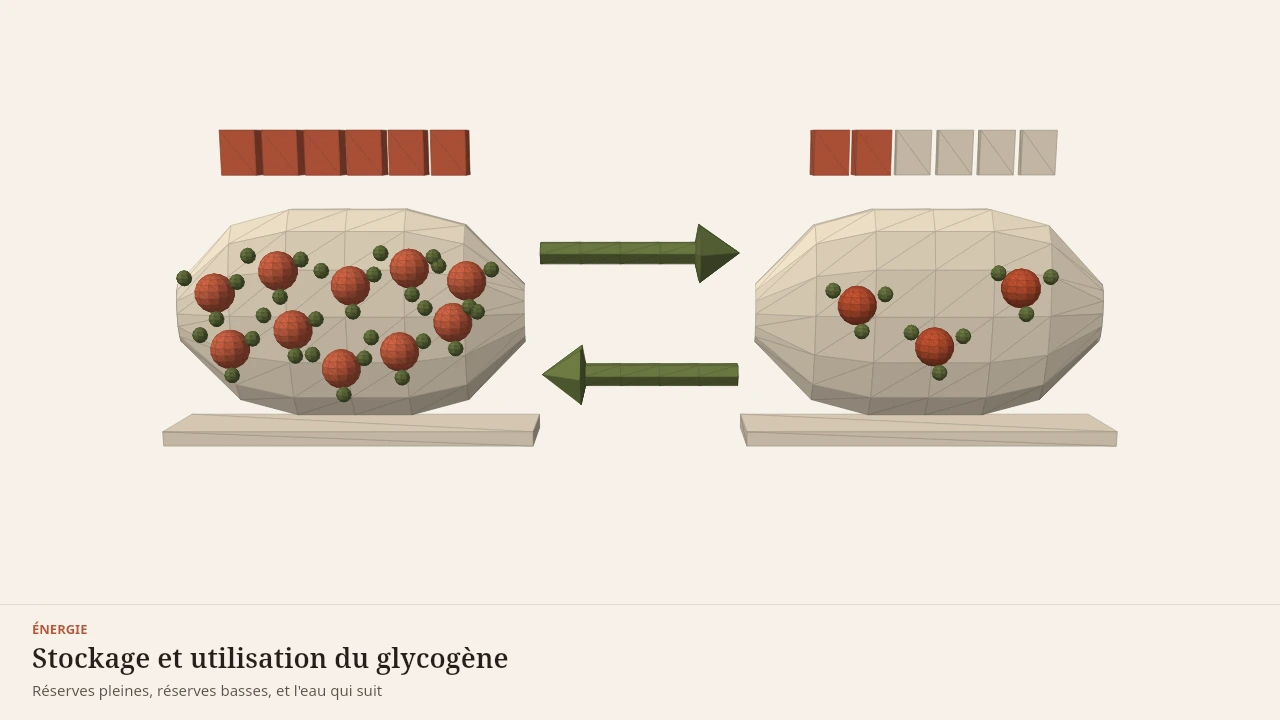
On the left, a muscle fibre opened along its length. The dark spheres spread inside stand for glycogen granules, the form in which muscle stores carbohydrate.
Scene description
Comparative diagram: two identical muscle fibres, opened lengthwise like slices, sit side by side on pale plinths. The left one, with full stores, holds about ten dark spheres — the glycogen granules — each ringed by three small spheres standing for the water stored with it; above it, a six-segment gauge is completely filled. The right one, with low stores, holds only three granules and their water, and its gauge shows just two solid segments followed by four hollow ones. Between the two fibres, an upper arrow pointing right represents the effort that empties the store, and a lower arrow pointing left represents the dietary refuelling that rebuilds it. Sizes and counts are symbolic: nothing here is to scale.
Visible structures
- Glycogen granuleGlycogen is the form in which muscle stores carbohydrate. It is gathered into granules spread through the fibre, ready to be mobilised quickly during effort.
- Associated waterGlycogen is stored together with water, shown here as the small satellite spheres. When the store falls, that water leaves with it and the number on the scale follows, which says nothing about fat mass.
- Fibre in sectionThe fibre is drawn as a slice, as if it had been opened along its length. The section only serves to show what it contains.
- Low storesAfter a long effort, few granules are left. The fibre still works, but the intensity it can sustain drops.
- RefuellingDietary carbohydrate rebuilds glycogen, and the associated water comes back with it. This is one of the reasons the number on the scale moves from one day to the next.
Guided steps
- 1/5On the left, a muscle fibre opened along its length. The dark spheres spread inside stand for glycogen granules, the form in which muscle stores carbohydrate.
- 2/5Each granule is ringed by small spheres: the water stored alongside it. Glycogen and water travel together, which explains part of the day-to-day swings on the scale.
- 3/5During sustained effort the fibre breaks down its glycogen to produce energy. The upper arrow shows the move from one state to the other, and the group of granules shrinks.
- 4/5On the right, the same fibre after the effort: few granules, little associated water, an almost empty gauge. The number on the scale has dropped, but that particular drop comes from glycogen and its water, not from fat mass.
- 5/5Dietary carbohydrate rebuilds the store and the water returns with it: the lower arrow brings the fibre back to its full state. This back-and-forth repeats continuously, independently of fat mass.
Model licence · Shapier — Propriétaire — usage interne ShapierLab
Caution
What this page does not say
This page explains a storage mechanism. It gives no amount of carbohydrate to eat, proposes no diet and allows nobody's weight to be interpreted.
An unexplained, rapid or persistent change in weight is a matter for a healthcare professional who can examine the person concerned.
Sources for this video
- Burke LM, Hawley JA, Wong SHS, Jeukendrup AE (2011). Carbohydrates for training and competition. Journal of Sports Sciences.DOI : 10.1080/02640414.2011.585473
- Fernández-Elías VE, Ortega JF, Nelson RK, Mora-Rodriguez R (2015). Relationship between muscle water and glycogen recovery after prolonged exercise in the heat in humans. European Journal of Applied Physiology.DOI : 10.1007/s00421-015-3175-z
Check my understanding
What does the scale mostly measure when it shows several hundred grams of difference between two mornings?
A change in total mass, carried mostly by the water bound to glycogen
Fat gained or lost between the two weigh-ins
A fast change in muscle tissue itself
What should be remembered about the figure of roughly three grams of water per gram of glycogen?
An order of magnitude measured under particular conditions, not a constant
A constant that holds for every person and every situation
A ratio measured in a very large number of people at rest
How does the page tell apart the glycogen held in muscle and the store kept in the liver?
Muscle glycogen first serves the muscle that holds it, while the liver store keeps glucose available to the body as a whole
Both stores play exactly the same role in the body
Liver glycogen is used by the muscle before its own granules
Choose an answer
Read next
- Muscle glycogen and waterWhy can the number on the scales change within two days without any change in fat mass? This page explains what muscle glycogen is, its role as a fuel and the water that accompanies it inside the muscle.With a 3D scene
- ATP and phosphocreatineWhere does the energy for the very first seconds of a maximal effort come from? This page describes the energy currency of muscle, the buffering role of phosphocreatine, and why the energy systems do not take turns the way they are usually described.With a 3D scene
- Energy and recoveryA six-step reading pathway that follows muscle energy from the second to the night: the instant recharge of ATP, the glycogen stores and their water, then the role of sleep. A closing quiz lets you check what you have taken in.Described without a scene
Put it into practice in Shapier
Explore nutrition around training in Shapier
Find in Shapier the dossier for organising carbohydrate intake around the sessions of the training week.
Explore nutrition around training in Shapier
Body Lab explains; Shapier lets you act and track.
Available offline
Offline download is available in the mobile app.
Trust and method
Author
Editorial review
Thanh Chau
Published on
August 2, 2026
Reviewed on August 2, 2026
Next review due August 2, 2027
Limits of this page
- The ratio between water and glycogen was measured in small groups of trained adults, after prolonged exercise in the heat: it does not transfer as it stands to every situation.
- The number shown by a scale also depends on gut contents, on overall hydration and on other factors this page does not cover.
- None of the data cited makes it possible to interpret one person's weight change or to draw any dietary conclusion from it.
Educational content. Body Lab does not diagnose and does not replace professional advice.
How we work