What makes a muscle grow?
Key point
The answer in three sentences
An exercise demanding enough imposes mechanical tension on the fibres that are working. This tension is detected by the muscle cell, which for a few tens of hours increases its manufacture of contractile proteins.
Repeated over weeks, and provided that manufacture exceeds breakdown over time, this succession of small imbalances results in thicker fibres. The rest of the page details each link and flags those that remain debated.
A bigger muscle is not, in the standard description in adult humans, a muscle that has manufactured new fibres. It is mostly the fibres already present that thicken. The central question of this page is therefore a precise one: what makes a muscle fibre end up containing more contractile material than before?
Answering it means following a chain, not an isolated event: a load is applied, detected by the cell, translated into a chemical response, and it is the repetition of this temporary imbalance over weeks that produces a visible change.
Hypertrophy
Increase in the size of existing muscle fibres, mainly through the accumulation of contractile proteins inside the fibre. To be distinguished from hyperplasia, the increase in the number of fibres, whose contribution in adult humans remains poorly documented.
muscle growth · gaining muscle
What does muscle growth mean at fibre level?
A muscle fibre is a very long cell, filled with myofibrils arranged in parallel. Each myofibril is a succession of sarcomeres, the units that shorten during contraction. For a fibre, growing amounts to adding contractile proteins and increasing its cross-sectional area.
This accumulation is not decided all at once. The muscle manufactures and breaks down proteins continuously, including at rest; what training changes is the balance between the two.
Muscle protein balance
Difference, over a given period, between the amount of protein manufactured by the muscle and the amount broken down. A lastingly positive balance is the condition for hypertrophy; a prolonged negative balance accompanies loss of mass instead.
net protein balance
Certainty level · Established
Resistance training increases the size of muscle fibres, and this increase works through a net accumulation of protein within the fibre.
This is the least disputed point in the field, described consistently from muscle biopsies, imaging and cross-sectional area measurements. What remains debated is not the fact of hypertrophy, but the hierarchy of the signals that trigger it.
Schoenfeld BJ (2010) · Wackerhage H, Schoenfeld BJ, Hamilton DL, Lehti M, Hulmi JJ (2019)
How does a set lead to a thicker muscle fibre?
The time markers below are orders of magnitude taken from the reviews cited, not values valid for any given person.
What follows a resistance training session
- 1During the setEffortThe recruited fibres produce force under load. The tension applies to the contractile structures as well as to the envelope of the fibre.
- 2Just afterwardsMinutesIntracellular signalling pathways change their activity, among them the mTOR pathway, associated with the start-up of protein manufacture.
- 3Rise in synthesisFirst hoursThe rate at which muscle proteins are manufactured rises above its resting level.
- 4Plateau then returnOne to two daysSynthesis gradually comes back down towards its baseline value, the faster the more trained the person is.
- 5Between two sessionsFollowing daysThe net balance depends on the repetition of sessions, on dietary intake and on rest. An isolated session leaves no lasting trace.
- 6Measurable changeWeeksThe accumulation of cycles eventually produces a change in size detectable by the usual measurement methods.
Certainty level · Probable
The rise in protein synthesis after a session lasts roughly one to two days, and its shape changes with training.
The reviews describe a rise during the first hours then a gradual return to baseline. In untrained people this initial response is longer and more scattered, and partly devoted to repair rather than to growth. The exact durations vary with the measurement method, the muscle studied and nutritional status, which rules out drawing any precise schedule from them.
Damas F, Phillips SM, Vechin FC, Ugrinowitsch C (2015) · Atherton PJ, Smith K (2012)
Timeline of muscular adaptation
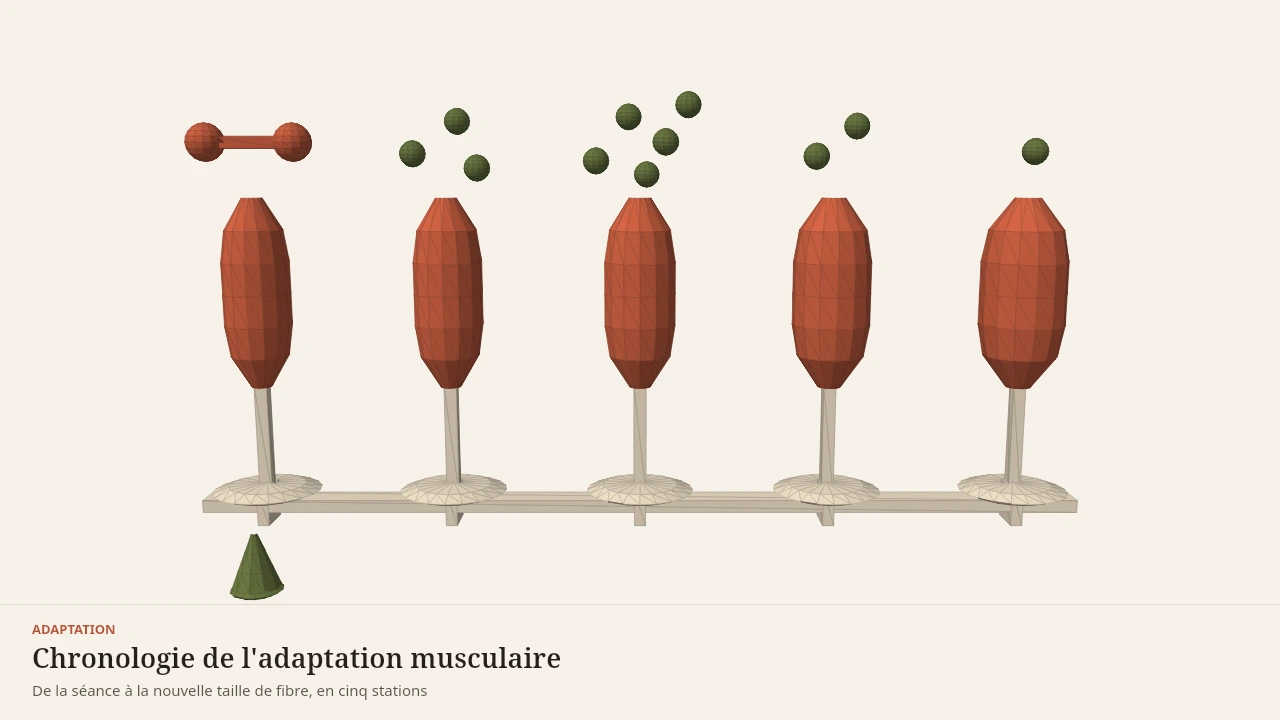
The scene runs through the same stages as the timeline above, from the effort to the accumulation over several weeks. Each stage stays readable in the text, without the visualisation.
Current step
1. The training session
A demanding enough set puts mechanical tension on the fibres that are working. At this point nothing has changed yet in the structure of the muscle: the session is a signal, not a gain.
Scene description
Timeline diagram: five evenly spaced stations along a horizontal time axis, each topped by a muscle fibre drawn as a vertical capsule. From left to right the stations stand for the training session, the damage and the signalling it triggers, the period of elevated protein synthesis, the remodelling of the fibre, and the new fibre size that results. The capsules grow slightly wider from one station to the next, while a cluster of small spheres above each station shows how intense the signalling is: a schematic dumbbell at the first station, the densest cluster at the third, almost nothing at the fifth. A marker in front of the axis points at the current stage and moves from station to station. The volumes are reading aids: neither the proportions nor the durations are to scale.
Visible structures
- Training sessionA demanding set puts mechanical tension on the fibres that are working. It triggers everything that follows, but it is not yet an adaptation.
- Cellular signalsThe effort disturbs the inside of the fibre and sets off chemical signals. These signals build nothing on their own: they direct what the cell does next.
- Elevated protein synthesisIn response to the signals, the fibre makes proteins faster than it breaks them down. This rise is temporary and settles back toward its usual level.
- New fibre sizeThe cross-section of the fibre only grows through repeated cycles. The diameter shown here is a reading aid, not a measurement.
- Time axisThe axis orders the events from left to right. The intervals are evenly spaced for legibility: they do not represent real durations.
Guided steps
- 1/5A demanding enough set puts mechanical tension on the fibres that are working. At this point nothing has changed yet in the structure of the muscle: the session is a signal, not a gain.
- 2/5The effort disturbs the inside of the fibre and sets off a cascade of chemical signals. They tell the cell to repair and reinforce itself; they do not build any protein on their own.
- 3/5Driven by those signals, the fibre assembles new proteins faster than it breaks them down. This is when the balance turns positive, and the signalling cluster is at its densest here.
- 4/5The new proteins are built into the existing contractile structures. The muscle does not swell all at once: it reorganises itself, and signalling activity subsides.
- 5/5When this cycle repeats regularly, the cross-section of the fibre eventually increases. The visible result is the sum of many tiny adaptations, never the product of a single session.
Model licence · Shapier — Propriétaire — usage interne ShapierLab
Three proposed mechanisms, and their status
The reference review groups the explanations put forward into three mechanisms, which are not mutually exclusive: they describe three consequences of the same exercise. The issue is to work out which one is necessary and which one is merely associated.
The three proposed mechanisms
Mechanism
What it describes
Status in the literature
Mechanical tension
The load borne by active fibres when they produce force under resistance
Regarded as the leading candidate
Muscle damage
Structural disturbance of the fibre and the repair response that follows
Its own contribution debated, possibly incidental
Metabolic stress
The accumulation of metabolites during continuous effort under reduced blood flow
Association observed, causal role unresolved
Certainty level · Probable
Mechanical tension is regarded as the main trigger of hypertrophy.
This conclusion rests on the convergence of several types of work: protocols comparing different loads, animal models of overload, and descriptions of signalling pathways sensitive to loading. It remains a probable hierarchy and not a direct demonstration, because isolating tension from the other consequences of exercise is experimentally difficult in humans.
Schoenfeld BJ (2010) · Wackerhage H, Schoenfeld BJ, Hamilton DL, Lehti M, Hulmi JJ (2019)
Certainty level · Uncertain
The cellular sensor that translates mechanical tension into a growth signal has not been identified with certainty.
Several candidates are proposed, in the sarcomere, at the anchoring points of the cell or in the membrane. None commands a consensus, and several may coexist. This uncertainty concerns the molecular explanation of the trigger, not the existence of hypertrophy.
Wackerhage H, Schoenfeld BJ, Hamilton DL, Lehti M, Hulmi JJ (2019)
Which variables influence muscle growth?
What does the size of the response depend on? The following variables come up most often in the syntheses.
- Weekly training volume per muscle group, that is, the number of sets performed over the
week.
- The demand imposed, a combination of the load and how close the effort comes to maximal at
the end of the set.
- The distribution across the week, which determines how many times the signal is
renewed.
- Dietary intake, in particular protein intake and total energy
intake.
- Recovery, including sleep, which conditions the ability to repeat
sessions.
- Individual factors: age, training history, health status and a share of genetic variability
that is still poorly characterised.
Certainty level · Established
Weekly volume and protein intake are two variables whose effect is supported by meta-analyses.
The meta-analysis on volume reports a graded relationship between the number of weekly sets per muscle group and the gain in muscle mass. The one on protein reports that supplementation increases gains in lean mass and strength in healthy adults who train, with a modest average effect and a ceiling beyond which no further benefit is detected. These results describe population averages and set no individual value.
Schoenfeld BJ, Ogborn D, Krieger JW (2017) · Morton RW, Murphy KT, McKellar SR, Schoenfeld BJ, Henselmans M, Helms E, Aragon AA, Devries MC, Banfield L, Krieger JW, Phillips SM (2018)
What this implies in practice, and what it does not
The mechanism suggests three general principles. Growth requires a sufficient and repeated signal, so progress is read over weeks and not over sessions. It requires the body to have material and energy available, so diet has to follow. And it requires the ability to start again, which gives recovery a structural role.
What the mechanism does not say matters just as much. It indicates neither how many sets a given person should perform, nor at what frequency, nor with what load. The average values from meta-analyses describe groups; they do not transfer as they stand to an individual, whose age, history and health status modify the response.
Certainty level · Teaching simplification
The picture of a muscle “torn in training then rebuilt bigger” is a teaching simplification, not a description of the mechanism.
Structural disturbances do occur after unaccustomed exercise, but their causal role is debated, and their repair consumes part of the synthesis response instead of directing it towards growth. Presenting damage as the cause of hypertrophy reverses part of the relationship described in the literature.
Schoenfeld BJ (2010) · Damas F, Phillips SM, Vechin FC, Ugrinowitsch C (2015)
Limits, and situations that call for professional advice
The work cited concerns mostly young, healthy adults, often men, followed over a few weeks to a few months. Measurement methods vary and variability between individuals remains substantial, including with an identical protocol. An association observed in a meta-analysis does not on its own demonstrate a cause-and-effect link for any particular person.
Caution
When to seek professional advice
This page describes a general mechanism. It does not replace an examination and does not make it possible to interpret an individual situation.
Medical advice, or that of a qualified professional, is appropriate in case of pain that persists or increases, unexplained loss of strength, chronic illness, pregnancy, ongoing treatment, or before returning to training after an injury. Pain should never be ignored on the grounds that it is part of the process.
Key sources
- Schoenfeld BJ (2010). The mechanisms of muscle hypertrophy and their application to resistance training. Journal of Strength and Conditioning Research.DOI : 10.1519/jsc.0b013e3181e840f3
- Wackerhage H, Schoenfeld BJ, Hamilton DL, Lehti M, Hulmi JJ (2019). Stimuli and sensors that initiate skeletal muscle hypertrophy following resistance exercise. Journal of Applied Physiology.DOI : 10.1152/japplphysiol.00685.2018
- Damas F, Phillips SM, Vechin FC, Ugrinowitsch C (2015). A review of resistance training-induced changes in skeletal muscle protein synthesis and their contribution to hypertrophy. Sports Medicine.DOI : 10.1007/s40279-015-0320-0
- Schoenfeld BJ, Ogborn D, Krieger JW (2017). Dose-response relationship between weekly resistance training volume and increases in muscle mass: A systematic review and meta-analysis. Journal of Sports Sciences.DOI : 10.1080/02640414.2016.1210197
- Morton RW, Murphy KT, McKellar SR, Schoenfeld BJ, Henselmans M, Helms E, Aragon AA, Devries MC, Banfield L, Krieger JW, Phillips SM (2018). A systematic review, meta-analysis and meta-regression of the effect of protein supplementation on resistance training-induced gains in muscle mass and strength in healthy adults. British Journal of Sports Medicine.DOI : 10.1136/bjsports-2017-097608
- Atherton PJ, Smith K (2012). Muscle protein synthesis in response to nutrition and exercise. The Journal of Physiology.DOI : 10.1113/jphysiol.2011.225003
Put it into practice in Shapier
Organise your sessions and rest days
Spreading sessions and rest days across the week is done in Shapier; Body Lab only explains why that distribution matters.
Organise your sessions and rest days
Body Lab explains; Shapier lets you act and track.
Read next
- Mechanical tension, fatigue and volumeShould you lift heavy, train to exhaustion, or simply do a lot? This page untangles three variables that are often confused, shows how they combine over the course of a set, and states the level of evidence behind each one.With a 3D scene
- Muscle protein synthesisWhat happens when muscle manufactures proteins, and is that manufacture enough to predict growth? This page describes the response to exercise and to food, and explains why a single snapshot measurement is so often misleading.With a 3D scene
- How muscle grows — the videoAn animation that follows a muscle fibre from the mechanical signal produced during effort through to the contractile proteins added over the following days. The page carries the same content in text, with its sources and the limits of the simplification.With a 3D scene
- Understanding muscle growthA six-step reading pathway that connects the mechanical signal produced during a set, the protein building that follows, and the volume of work accumulated over a week. A quiz at the end lets you check what you have taken in.Described without a scene
Check my understanding
In adult humans, what mainly changes during hypertrophy?
Existing fibres get thicker
The muscle manufactures many new fibres
The fibres fill with fat
What is the status of mechanical tension in the literature cited?
Leading candidate, hard to isolate experimentally
Sole and demonstrated cause of hypertrophy
A mechanism abandoned by recent research
Choose an answer
Available offline
Offline download is available in the mobile app.
Trust and method
Author
Editorial review
Thanh Chau
Published on
August 2, 2026
Reviewed on August 2, 2026
Next review due August 2, 2027
Limits of this page
- The mechanisms described come mostly from short studies carried out in healthy young adults, often men; how far they transfer to other populations remains uncertain.
- The measures of muscle growth used in this work (imaging, biopsies, thickness measured by ultrasound) do not measure the same thing and do not always give consistent results.
- The timeline presented is an average order of magnitude: the speed and the size of the response vary considerably between people, and these individual differences remain poorly explained.
- This page describes a general mechanism and makes it possible neither to assess nor to programme the training of any particular person.
Educational content. Body Lab does not diagnose and does not replace professional advice.
How we work