Does protein synthesis explain muscle growth?
Muscle is not a fixed structure. It manufactures and dismantles its proteins continuously, including during sleep. Growth does not appear because manufacture starts, but because it exceeds breakdown repeatedly.
The central question of this page is therefore: is measuring the manufacture of muscle proteins enough to predict whether a muscle will grow? The answer is more nuanced than the usual summaries suggest, and that nuance is the main contribution of the past fifteen years of research.
Key point
The answer in three sentences
Exercise and protein intake both raise the rate at which muscle proteins are manufactured, and their combination produces a stronger response than either separately.
This rise is transient: it climbs, peaks, then comes back down, even if amino acids remain available. A measurement taken over a few hours therefore does not faithfully predict the growth observed after several weeks, which is reason for caution about any conclusion drawn from a single measurement window.
Muscle protein synthesis
Rate at which muscle assembles new proteins from amino acids. It is measured over a window of a few hours, by tracking the incorporation of a labelled amino acid into tissue taken by biopsy.
manufacture of muscle proteins
What the muscle builds, and how it is measured
The proteins concerned are not limited to contractile proteins. Muscle also renews its enzymes, its supporting structures and its mitochondrial components, and these compartments do not respond in the same way to the same exercise. Overall measurements add these responses together, which explains part of the divergence between studies.
The dominant method consists in circulating a tracer and then comparing biopsies taken a few hours apart. It gives an average rate over the window observed, never a continuous curve.
Certainty level · Established
Resistance exercise and dietary protein intake each increase muscle protein synthesis, and their combination produces a greater response.
This result is reproduced across many protocols and is the subject of agreement between review articles. It concerns the rate of manufacture measured over a few hours in healthy adults, and says nothing on its own about the extent of long-term growth.
Atherton PJ, Smith K (2012) · Phillips SM, Van Loon LJC (2011)
What triggers the rise
Two distinct signals converge. The first is mechanical: the load imposed on the fibres during effort is translated into an intracellular signal. The second is nutritional: the arrival of amino acids in the blood, particularly after a meal containing protein, acts both as a substrate and as a signal.
mTOR
Protein complex that acts as a point of convergence within the muscle cell. Its activity increases both after mechanical loading and after the arrival of amino acids, and it is associated with the start-up of protein manufacture. The word refers to a signalling pathway, not to a substance to be consumed.
mTOR pathway · mTORC1
Certainty level · Uncertain
The exact chain linking mechanical loading to the activation of this pathway has not been fully elucidated.
Several candidate sensors are described, without any of them commanding a consensus, and the relative importance of the mechanical signal and the nutritional signal varies across experimental models. The existence of the response is solid; its detailed molecular explanation remains an open question.
Wackerhage H, Schoenfeld BJ, Hamilton DL, Lehti M, Hulmi JJ (2019)
Timeline of a response
From a protein-containing meal and a session to protein manufacture
- 1StimulusStartA resistance training session, a meal containing protein, or the two close together.
- 2Signal availableFirst hourAmino acids arrive in the circulation; in parallel, mechanical loading has already changed intracellular signalling.
- 3RiseOne to three hoursThe rate at which muscle proteins are manufactured climbs clearly above its resting value.
- 4Return towards baselineA few hoursThe rate comes back down, including when amino acids remain available in the blood.
- 5Extended sensitivityOne to two daysAfter exercise, muscle responds more strongly to protein intake than at rest, over a period that extends beyond the day of the session alone.
- 6AccumulationWeeksThe sum of daily balances, positive or negative, determines the change in size that eventually becomes measurable.
Certainty level · Probable
The synthesis response to protein intake is transient and ends before amino acids disappear from the blood.
Infusion studies describe a rise then a fall within a few hours, while blood concentration stays elevated: a saturation effect appears to limit the duration of the response. This behaviour is observed repeatedly in healthy young adults, but its size and duration vary with the amount ingested, the protein source and training status.
Atherton PJ, Smith K (2012)
Protein synthesis, simplified
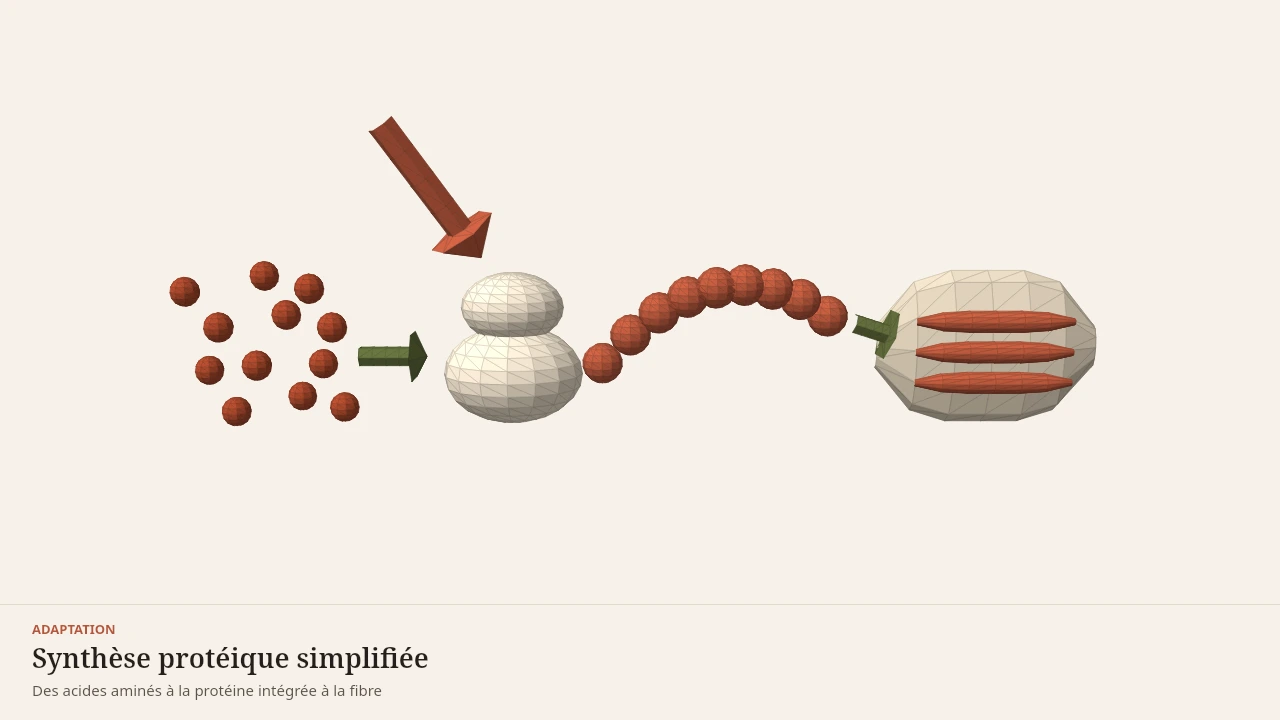
The scene represents the path from a signal to the assembly of new proteins in the fibre. It is a simplified representation, meant to situate the stages described in the text, and not a faithful reproduction of the cell.
Current step
1. The training signal
The arrow coming down from the left stands for the signal left by the session. It supplies no raw material: it temporarily raises the rate at which the fibre assembles proteins.
Scene description
Flow diagram read from left to right. On the left, a dozen scattered small dark spheres stand for the available amino acids; a short arrow leads them toward the centre. In the middle, two stacked rounded volumes — the two subunits of the ribosome — receive a slanted arrow from above representing the signal left by training. To their right, nine terracotta spheres strung along a curve that rises and then falls form the growing peptide chain, each sphere a link added after the previous one. At the far right, an arrow leads to a pale capsule, the muscle fibre, in which three parallel terracotta filaments represent the contractile protein once it is built in. Proportions and counts are symbolic: the diagram deliberately merges several molecular steps.
Visible structures
- Amino acidsAmino acids are the building blocks of proteins. They come from food and from the constant recycling of the body's own proteins; without them available, nothing can be assembled.
- RibosomeThe ribosome is the cell's assembly machine. Made of two subunits, it reads a message and joins amino acids to one another in the order it specifies.
- Peptide chainAmino acids joined end to end form a chain that grows one link at a time. The chain then folds to become a working protein.
- Contractile proteinOnce folded, the protein is built into the filaments that produce force. It is this incorporation, repeated over and over, that gradually changes the structure of the fibre.
- Training signalTraining temporarily raises the rate of synthesis. It supplies no material: it acts as an instruction sent to the assembly machine.
Guided steps
- 1/5The arrow coming down from the left stands for the signal left by the session. It supplies no raw material: it temporarily raises the rate at which the fibre assembles proteins.
- 2/5On the left, the cluster of small spheres stands for the amino acids circulating in the cell. They are the building blocks: the signal is useless if they are missing.
- 3/5The ribosome, drawn as two stacked volumes, reads a message and joins the amino acids in exactly the order it specifies. This is where material and information meet.
- 4/5The links appear one after another along the curve: the growing peptide chain. It will then fold on itself to become a working protein.
- 5/5On the right, the finished protein is built into the contractile filaments of the fibre. Repeated relentlessly, this incorporation is what eventually changes the structure of the muscle.
Model licence · Shapier — Propriétaire — usage interne ShapierLab
What makes the size of the response vary
Variables that modulate the synthesis response
Variable
Reported effect on the response
Level of evidence
Preceding exercise
Response to protein intake stronger than at rest
Consistent result across reviews
Amount of protein ingested
Rising response then a plateau
Described, with thresholds that vary between studies
Protein source and amino acid profile
Different size and speed depending on the source
Described, comparisons often indirect
Age
Blunted response with advancing age
Documented, mechanisms debated
Overall energy intake
Reduced response under marked deficit
Less documented, limited data
These variables interact, and none can be read in isolation. They are presented here to situate what the studies compare, not as parameters to be adjusted.
The trap of the single measurement
This is the most counter-intuitive point in the field. A large rise in synthesis measured just after a session does not necessarily signal substantial future growth. In someone starting out, part of that manufacture goes towards repairing structures disturbed by unaccustomed exercise, rather than towards adding contractile material.
Certainty level · Probable
In untrained people, the rise in synthesis measured during the first sessions correlates poorly with the hypertrophy observed subsequently.
The review describes a gradual reorientation: as the disturbances caused by unaccustomed exercise fade over the weeks, the synthesis measured becomes better linked to gains in size. This description rests on a limited number of studies with small samples, which invites treating it as a solid but not definitive trend.
Damas F, Phillips SM, Vechin FC, Ugrinowitsch C (2015)
What this implies in practice
Three general consequences emerge. An impressive acute response is not proof of long-term effectiveness, which justifies caution about arguments based on a single measurement. Regularity of protein intake matters more than the search for an ideal moment, since the response is transient and renews itself. And exercise and diet act together: one does not make up for the absence of the other.
Certainty level · Teaching simplification
The “anabolic window” of a few minutes after a session is a simplification that has become misleading.
The muscle's sensitivity to protein intake stays elevated well beyond the minutes that follow the effort, and the meta-analysis on supplementation does not conclude that the timing of intake has a decisive effect on the gains obtained. The urgency message has outlived the data that qualified it.
Phillips SM, Van Loon LJC (2011) · Morton RW, Murphy KT, McKellar SR, Schoenfeld BJ, Henselmans M, Helms E, Aragon AA, Devries MC, Banfield L, Krieger JW, Phillips SM (2018)
Limits, and situations that call for professional advice
No amount, no timing and no distribution are given on this page, and the average values from meta-analyses do not transfer to an individual. Suitable protein intake depends on age, activity, health status and kidney function, all of which are matters for professional assessment.
Caution
When to seek professional advice
This page describes a physiological mechanism. It constitutes neither nutritional advice, nor an intake recommendation, nor an assessment of any diet.
The advice of a doctor or a dietitian is appropriate in case of kidney, liver or metabolic disease, pregnancy, ongoing treatment, unexplained loss of weight or muscle mass, an eating disorder, or before any major change of diet.
Key sources
- Atherton PJ, Smith K (2012). Muscle protein synthesis in response to nutrition and exercise. The Journal of Physiology.DOI : 10.1113/jphysiol.2011.225003
- Damas F, Phillips SM, Vechin FC, Ugrinowitsch C (2015). A review of resistance training-induced changes in skeletal muscle protein synthesis and their contribution to hypertrophy. Sports Medicine.DOI : 10.1007/s40279-015-0320-0
- Phillips SM, Van Loon LJC (2011). Dietary protein for athletes: from requirements to optimum adaptation. Journal of Sports Sciences.DOI : 10.1080/02640414.2011.619204
- Morton RW, Murphy KT, McKellar SR, Schoenfeld BJ, Henselmans M, Helms E, Aragon AA, Devries MC, Banfield L, Krieger JW, Phillips SM (2018). A systematic review, meta-analysis and meta-regression of the effect of protein supplementation on resistance training-induced gains in muscle mass and strength in healthy adults. British Journal of Sports Medicine.DOI : 10.1136/bjsports-2017-097608
- Wackerhage H, Schoenfeld BJ, Hamilton DL, Lehti M, Hulmi JJ (2019). Stimuli and sensors that initiate skeletal muscle hypertrophy following resistance exercise. Journal of Applied Physiology.DOI : 10.1152/japplphysiol.00685.2018
Put it into practice in Shapier
Track everyday protein in Shapier
Food tracking and practical guidance on protein are found in Shapier; Body Lab only explains the underlying mechanism.
Track everyday protein in Shapier
Body Lab explains; Shapier lets you act and track.
Read next
- How muscle growsWhat actually makes a muscle grow? This page follows the chain of events that links a set of exercise to a thicker muscle fibre, and separates what is established from what is still debated by research.With a 3D scene
- Mechanical tension, fatigue and volumeShould you lift heavy, train to exhaustion, or simply do a lot? This page untangles three variables that are often confused, shows how they combine over the course of a set, and states the level of evidence behind each one.With a 3D scene
- Sleep and recoveryWhat does sleep actually do for recovery? This page describes the architecture of a night, what sleep deprivation changes in a documented way, and clearly separates established results from hypotheses that are still open.With a 3D scene
- Protein synthesis visualised — the videoAn animation that shows muscle as a permanent building site: proteins are broken down while others are assembled, and it is the difference between the two, repeated day after day, that decides whether the fibre gets bigger.With a 3D scene
Check my understanding
Does the protein synthesis response to a protein-containing meal last as long as amino acids are available?
No, it comes back down before amino acids disappear from the blood
Yes, it is maintained as long as the blood contains amino acids
It never comes back down after a protein-containing meal
Does a large rise in synthesis measured after a first session announce substantial growth?
Not necessarily, part of it goes to repair in beginners
Yes, the relationship is direct and systematic
No, protein synthesis has nothing to do with growth
Choose an answer
Available offline
Offline download is available in the mobile app.
Trust and method
Author
Editorial review
Thanh Chau
Published on
August 2, 2026
Reviewed on August 2, 2026
Next review due August 2, 2027
Limits of this page
- Measurements of protein synthesis rely on tracers and biopsies taken over windows of a few hours: they describe a snapshot and not the whole of the period studied.
- The correspondence between the acute rise in synthesis and the growth observed after several weeks is not systematic, particularly in untrained people.
- The work cited concerns mainly healthy young adults; older, ill or energy-deficient people show different responses that are not described here.
- This page contains no amounts, no timing of intake and no individual dietary advice.
Educational content. Body Lab does not diagnose and does not replace professional advice.
How we work