A muscle is not a fixed structure that training simply thickens. It is a permanent building site, where proteins are dismantled while others are put together. The video shows that back-and-forth and what tips it one way.
Protein synthesis visualised
Duration: 1:24
Chapters
Transcript
Muscle renews itself constantly: it builds and breaks down proteins every day. Muscle mass depends on the balance between these two flows, not on one of them alone.
Amino acids from food are the available building blocks. The ribosome assembles them into chains following the plan carried by messenger RNA. The proteins formed this way reinforce the contractile apparatus of the fibre.
A meal containing protein raises synthesis for a few hours. Resistance training raises the same response for longer and makes it more specific to the muscles worked. The two effects combine.
After a session, synthesis stays elevated well beyond the end of the effort. It is this period, repeated session after session, that produces an adaptation visible over several weeks. No single meal and no single session is enough.
What the video shows
The animation opens on a muscle fibre seen from the inside, with two flows drawn side by side. On the left, worn contractile proteins are broken down into amino acids: this is breakdown. On the right, amino acids are assembled into new proteins: this is muscle protein synthesis. Both flows run continuously, even at rest.
A pair of scales then appears in the middle of the frame. As long as the two flows balance out, the fibre keeps the same size. That is the main message of the video: growth does not come from breakdown stopping, but from a repeated imbalance in favour of building.
Two events then tip the scales. A meal containing protein sends a wave of amino acids into the cell, and the building flow speeds up noticeably. The video then shows the effect of a resistance session: the same wave of amino acids produces a stronger, longer-lasting response when the muscle has just been worked.
The closing shot widens the time scale. Peaks of building follow one another over several days, and the animation traces the curve of the fibre's size: it does not rise at every peak, it rises by accumulation.
The sequence of events shown in the video
- 1Rest, fastedBaseline stateBuilding and breakdown both tick over slowly and roughly balance each other.
- 2After protein is taken inShort responseAmino acids flood in, building speeds up, then returns towards baseline even while amino acids remain available.
- 3After a resistance sessionExtended responseThe muscle that has been worked responds more strongly to the same intake, and for longer than a meal on its own.
- 4Across several daysAccumulationThe sum of successive imbalances, rather than any single peak, shows up as a change in the size of the fibre.
A short response, not a switch
The least intuitive sequence in the video is the return to baseline: the building flow drops back while amino acids are still present. The cell does not keep building indefinitely just because it is being supplied.
Certainty level · Established
Muscle protein synthesis rises briefly after amino acids are taken in, then falls back even when amino acid availability is maintained.
Reviews of how muscle responds to nutrition and exercise describe a short-lived rise after protein is eaten, followed by a return towards baseline, and a larger, longer response when the intake follows a bout of resistance exercise. Those measurements rest on isotope tracers used over a few hours, in small groups of healthy adults: they illuminate the mechanism without predicting the outcome of a whole programme.
Atherton PJ, Smith K (2012)
From a one-off response to a visible result
A rise measured in a laboratory is not a gain in muscle. What links the two is repetition, and conditions where intake is sufficient.
Certainty level · Probable
Sufficient protein intake, combined with repeated resistance training, is associated with larger gains in muscle mass.
A meta-analysis carried out in healthy adults reports a favourable effect of additional protein intake on the mass and strength gained through resistance training, with an effect that stops rising beyond roughly 1.6 grams of protein per kilogram of body weight per day. Reviews on hypertrophy point out that food intake does not replace the mechanical stimulus. Those results are group averages and are not a personal instruction.
Morton RW, Murphy KT, McKellar SR, Schoenfeld BJ, Henselmans M, Helms E, Aragon AA, Devries MC, Banfield L, Krieger JW, Phillips SM (2018) · Schoenfeld BJ (2010)
The linked scene
Protein synthesis simplified
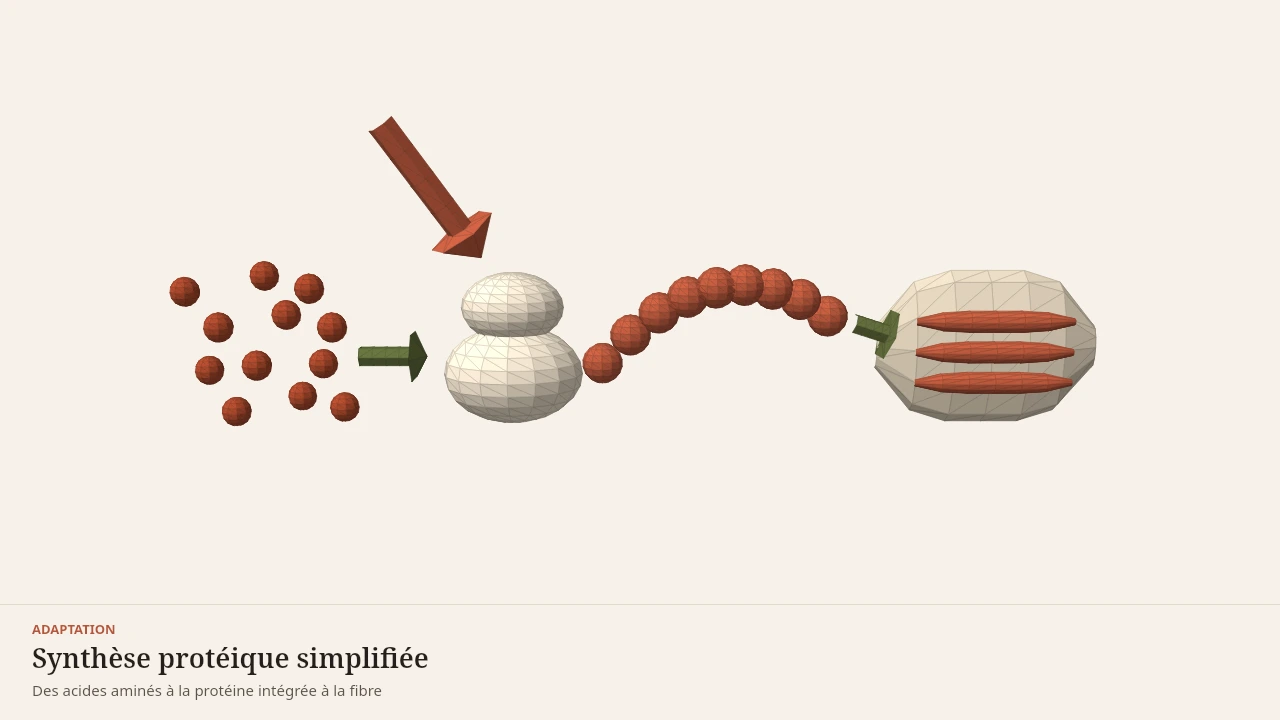
The scene takes the two flows from the video — breakdown and building — and lets you explore them step by step, at rest and then after protein is taken in. Every step is described in text below the scene and stays understandable without displaying the model.
Current step
1. The training signal
The arrow coming down from the left stands for the signal left by the session. It supplies no raw material: it temporarily raises the rate at which the fibre assembles proteins.
Scene description
Flow diagram read from left to right. On the left, a dozen scattered small dark spheres stand for the available amino acids; a short arrow leads them toward the centre. In the middle, two stacked rounded volumes — the two subunits of the ribosome — receive a slanted arrow from above representing the signal left by training. To their right, nine terracotta spheres strung along a curve that rises and then falls form the growing peptide chain, each sphere a link added after the previous one. At the far right, an arrow leads to a pale capsule, the muscle fibre, in which three parallel terracotta filaments represent the contractile protein once it is built in. Proportions and counts are symbolic: the diagram deliberately merges several molecular steps.
Visible structures
- Amino acidsAmino acids are the building blocks of proteins. They come from food and from the constant recycling of the body's own proteins; without them available, nothing can be assembled.
- RibosomeThe ribosome is the cell's assembly machine. Made of two subunits, it reads a message and joins amino acids to one another in the order it specifies.
- Peptide chainAmino acids joined end to end form a chain that grows one link at a time. The chain then folds to become a working protein.
- Contractile proteinOnce folded, the protein is built into the filaments that produce force. It is this incorporation, repeated over and over, that gradually changes the structure of the fibre.
- Training signalTraining temporarily raises the rate of synthesis. It supplies no material: it acts as an instruction sent to the assembly machine.
Guided steps
- 1/5The arrow coming down from the left stands for the signal left by the session. It supplies no raw material: it temporarily raises the rate at which the fibre assembles proteins.
- 2/5On the left, the cluster of small spheres stands for the amino acids circulating in the cell. They are the building blocks: the signal is useless if they are missing.
- 3/5The ribosome, drawn as two stacked volumes, reads a message and joins the amino acids in exactly the order it specifies. This is where material and information meet.
- 4/5The links appear one after another along the curve: the growing peptide chain. It will then fold on itself to become a working protein.
- 5/5On the right, the finished protein is built into the contractile filaments of the fibre. Repeated relentlessly, this incorporation is what eventually changes the structure of the muscle.
Model licence · Shapier — Propriétaire — usage interne ShapierLab
Limit
What the video simplifies
Amino acids are drawn as identical, interchangeable bricks; in reality their roles differ, and some of them act as signals as well.
The animation leaves out the signalling pathways named in the literature, the turnover of the other proteins in the cell, and the exchanges with the rest of the body.
Sources for this video
- Atherton PJ, Smith K (2012). Muscle protein synthesis in response to nutrition and exercise. The Journal of Physiology.DOI : 10.1113/jphysiol.2011.225003
- Morton RW, Murphy KT, McKellar SR, Schoenfeld BJ, Henselmans M, Helms E, Aragon AA, Devries MC, Banfield L, Krieger JW, Phillips SM (2018). A systematic review, meta-analysis and meta-regression of the effect of protein supplementation on resistance training-induced gains in muscle mass and strength in healthy adults. British Journal of Sports Medicine.DOI : 10.1136/bjsports-2017-097608
- Schoenfeld BJ (2010). The mechanisms of muscle hypertrophy and their application to resistance training. Journal of Strength and Conditioning Research.DOI : 10.1519/jsc.0b013e3181e840f3
Read next
- Muscle protein synthesisWhat happens when muscle manufactures proteins, and is that manufacture enough to predict growth? This page describes the response to exercise and to food, and explains why a single snapshot measurement is so often misleading.With a 3D scene
- How muscle growsWhat actually makes a muscle grow? This page follows the chain of events that links a set of exercise to a thicker muscle fibre, and separates what is established from what is still debated by research.With a 3D scene
- Understanding muscle growthA six-step reading pathway that connects the mechanical signal produced during a set, the protein building that follows, and the volume of work accumulated over a week. A quiz at the end lets you check what you have taken in.Described without a scene
Put it into practice in Shapier
Read the guide on everyday protein intake
Find in Shapier the guide that follows protein intake across training days.
Read the guide on everyday protein intake
Body Lab explains; Shapier lets you act and track.
Available offline
Offline download is available in the mobile app.
Trust and method
Author
Editorial review
Thanh Chau
Published on
August 2, 2026
Reviewed on August 2, 2026
Next review due August 2, 2027
Limits of this page
- Protein synthesis is measured with isotope tracer methods covering a few hours: they describe a one-off response, not directly the result of several months of training.
- The work cited mostly involves small samples of healthy adults studied in a laboratory; the values vary with age, training level and nutritional state.
- The animation shows a single fibre: it leaves out the differences between fibre types and the other tissues renewing themselves at the same time.
Educational content. Body Lab does not diagnose and does not replace professional advice.
How we work