Lift heavy, train to exhaustion, or do a lot?
The question comes up in almost every discussion about training, and it is badly framed. It assumes that three things are in opposition, when they describe three different aspects of the same work: the load borne by the fibres, the state of fatigue in which they bear it, and the total amount of that work over the week.
The central question of this page is therefore the following: do tension, fatigue and volume refer to the same thing, and which of them is really linked to muscle growth?
Key point
The answer in three sentences
Mechanical tension is the stimulus regarded as the main one, but it cannot be measured directly in the gym. Fatigue is what makes it possible, at the end of a set, to impose that tension on a large number of fibres, without being the stimulus itself.
Weekly volume is the variable best documented by meta-analyses, because it approximates the number of genuinely demanding sets accumulated. The three combine: none of them is enough to describe training on its own.
What “mechanical tension” refers to exactly
Mechanical tension
Force borne by the structures of a muscle fibre when it produces force, whether shortening, lengthening or staying at a constant length. It depends on the load, but also on the number of fibres sharing that load at any given moment.
mechanical loading
The most frequent confusion is to equate mechanical tension with the load on the bar. These are two distinct things. The load is external; tension is what each active fibre bears, so the load divided, in a sense, among the fibres that are working. A moderate load lifted when few fibres are available can produce a high tension per fibre.
That is why a set taken well short of its limits with a heavy load and a set taken close to its limits with a moderate load can end up in situations that are closer than they appear, from the point of view of the active fibres.
Certainty level · Probable
Mechanical tension is the most likely stimulus for hypertrophy, but it is not measured directly in humans during training.
The reviews rely on comparisons of loads, animal models of overload and descriptions of signalling pathways sensitive to loading. What is manipulated in practice are indirect variables, load and effort, which are assumed to make tension vary. That assumed step is rarely verified in the protocols.
Schoenfeld BJ (2010) · Wackerhage H, Schoenfeld BJ, Hamilton DL, Lehti M, Hulmi JJ (2019)
What fatigue brings, and what it costs
Over the course of a set, force-producing capacity declines. To keep the movement going, the nervous system progressively calls on additional motor units. The last repetitions of a hard set are therefore the ones in which the greatest number of fibres works under load simultaneously.
Fatigue therefore has a function: it extends recruitment. But it also has a cost. Systematically continuing to the point of complete stop increases accumulated fatigue, lengthens recovery time and reduces the quality of subsequent sets, which can lower the total volume that can be completed.
Certainty level · Uncertain
The degree of proximity to failure needed to maximise growth is not established.
The reasoning about recruitment is consistent with the physiology described, but the protocols comparing different levels of effort use heterogeneous definitions and measures, and their results do not converge. This is a plausible model awaiting validation, not an established result.
Schoenfeld BJ (2010) · Wackerhage H, Schoenfeld BJ, Hamilton DL, Lehti M, Hulmi JJ (2019)
Volume, the best documented variable
Training volume
Amount of work carried out over a given period. In work on hypertrophy it is most often expressed as the number of demanding sets performed per muscle group per week.
weekly volume · sets per week
Volume has a decisive advantage for research: it can be counted. The result is the most solid body of evidence in the field, but also a risk of over-interpretation, because what is easy to measure ends up taking all the space.
Certainty level · Established
A graded relationship exists between weekly volume per muscle group and the gain in muscle mass.
The meta-analysis compares categories of weekly volume and observes gains that are greater the more weekly sets are performed. This relationship is an association observed across studies with different protocols, and not a demonstration of individual causality. No ceiling is identified, and the authors do not claim that increasing volume indefinitely would keep producing gains.
Schoenfeld BJ, Ogborn D, Krieger JW (2017)
How the three variables combine
One set, from the first to the last repetition
- 1First repetitionsStart of the setThe load is produced by only some of the available fibres; velocity stays high.
- 2Middle of the setIntermediate repetitionsForce capacity falls, movement velocity decreases and recruitment extends to new motor units.
- 3Last repetitionsEnd of the setRecruitment is at its widest; a large number of fibres works under load despite reduced velocity.
- 4End of the setFailure or a margin kept in reserveContinuing beyond that point mainly adds fatigue, whose cost has to be weighed against the stimulus gained.
- 5Rest between setsMinutesCapacity is partly restored; the length of the rest conditions the quality of the following sets.
- 6Accumulation over the weekSessions added togetherThe sum of demanding sets forms the weekly volume, the variable most closely linked to measured gains.
Three variables, three levels of evidence
Variable
What it describes
Level of evidence
Mechanical tension
The actual load borne by the active fibres
Probable main stimulus, never measured directly in the gym
Proximity to failure
The degree of fatigue reached at the end of the set
Plausible model, heterogeneous experimental results
Weekly volume
The number of demanding sets per muscle per week
Graded relationship supported by a meta-analysis
Timeline of muscular adaptation
The scene places the set and the training week within the wider timeline of adaptation. The same stages are described in the text above.
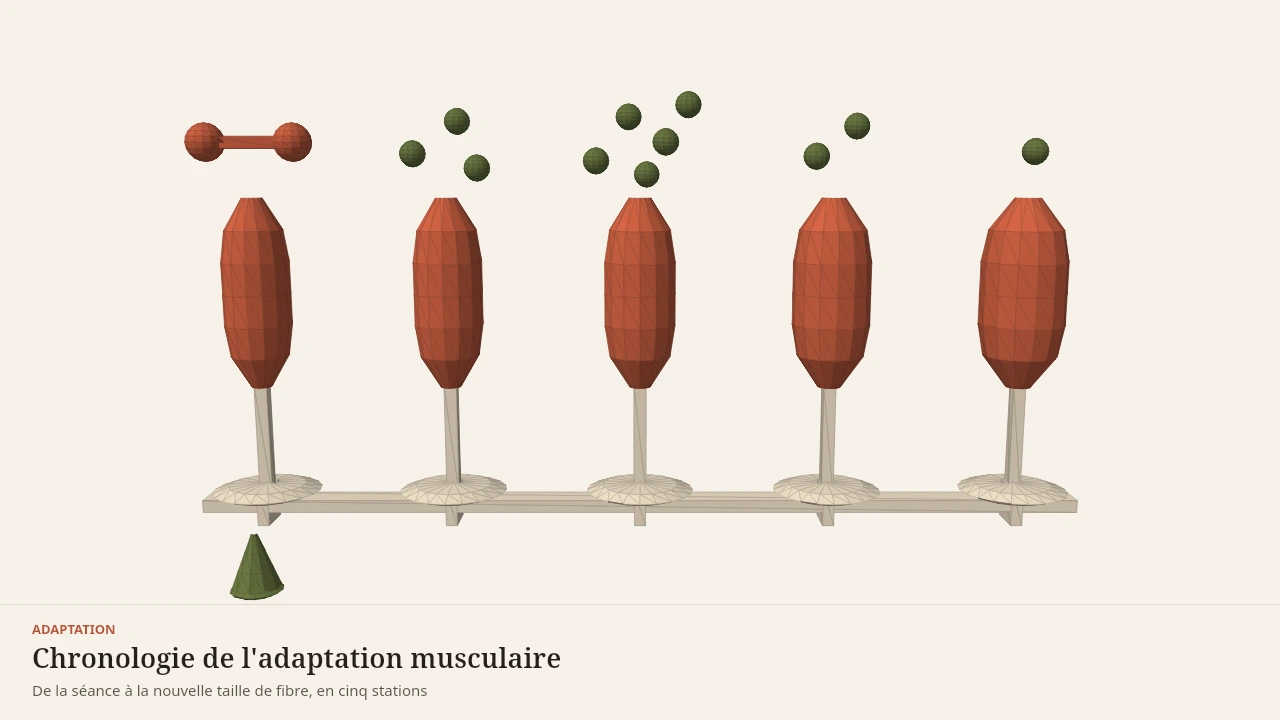
Current step
1. The training session
A demanding enough set puts mechanical tension on the fibres that are working. At this point nothing has changed yet in the structure of the muscle: the session is a signal, not a gain.
Scene description
Timeline diagram: five evenly spaced stations along a horizontal time axis, each topped by a muscle fibre drawn as a vertical capsule. From left to right the stations stand for the training session, the damage and the signalling it triggers, the period of elevated protein synthesis, the remodelling of the fibre, and the new fibre size that results. The capsules grow slightly wider from one station to the next, while a cluster of small spheres above each station shows how intense the signalling is: a schematic dumbbell at the first station, the densest cluster at the third, almost nothing at the fifth. A marker in front of the axis points at the current stage and moves from station to station. The volumes are reading aids: neither the proportions nor the durations are to scale.
Visible structures
- Training sessionA demanding set puts mechanical tension on the fibres that are working. It triggers everything that follows, but it is not yet an adaptation.
- Cellular signalsThe effort disturbs the inside of the fibre and sets off chemical signals. These signals build nothing on their own: they direct what the cell does next.
- Elevated protein synthesisIn response to the signals, the fibre makes proteins faster than it breaks them down. This rise is temporary and settles back toward its usual level.
- New fibre sizeThe cross-section of the fibre only grows through repeated cycles. The diameter shown here is a reading aid, not a measurement.
- Time axisThe axis orders the events from left to right. The intervals are evenly spaced for legibility: they do not represent real durations.
Guided steps
- 1/5A demanding enough set puts mechanical tension on the fibres that are working. At this point nothing has changed yet in the structure of the muscle: the session is a signal, not a gain.
- 2/5The effort disturbs the inside of the fibre and sets off a cascade of chemical signals. They tell the cell to repair and reinforce itself; they do not build any protein on their own.
- 3/5Driven by those signals, the fibre assembles new proteins faster than it breaks them down. This is when the balance turns positive, and the signalling cluster is at its densest here.
- 4/5The new proteins are built into the existing contractile structures. The muscle does not swell all at once: it reorganises itself, and signalling activity subsides.
- 5/5When this cycle repeats regularly, the cross-section of the fibre eventually increases. The visible result is the sum of many tiny adaptations, never the product of a single session.
Model licence · Shapier — Propriétaire — usage interne ShapierLab
What this implies in practice
Three general ideas follow from the above. The load is not the stimulus, it is one determinant among others. Fatigue is a means of reaching wide recruitment, not an end in itself. Volume is useful because it can be counted, but counting undemanding sets does not have the same meaning as counting sets taken close to their limits.
These findings define no programme. The number of sets, the load and the margin kept at the end of a set depend on training history, health status, available time and individual tolerance to fatigue, all of which vary considerably from one person to another.
Certainty level · Teaching simplification
Soreness does not measure the quality of a session.
It mainly reflects exposure to unaccustomed exercise and fades with repetition, even as growth continues. Using next-day pain as an indicator of stimulus amounts to mistaking a transient reaction for the mechanism of adaptation.
Schoenfeld BJ (2010) · Damas F, Phillips SM, Vechin FC, Ugrinowitsch C (2015)
Limits, and situations that call for professional advice
The available work covers short durations, restricted populations and standardised protocols that bear little resemblance to unsupervised training. The associations described between volume and gains do not make it possible to predict the response of any given person, and comparison between studies using different definitions remains fragile.
Caution
When to seek professional advice
This page explains a mechanism. It assesses no individual situation and proposes no programme.
Medical advice, or that of a qualified professional, is appropriate in case of persistent or increasing pain, joint discomfort, unusual fatigue that does not clear, chronic illness or ongoing treatment, as well as before returning to training after an injury. Pain should not be pushed through in the name of intensity.
Key sources
- Schoenfeld BJ (2010). The mechanisms of muscle hypertrophy and their application to resistance training. Journal of Strength and Conditioning Research.DOI : 10.1519/jsc.0b013e3181e840f3
- Schoenfeld BJ, Ogborn D, Krieger JW (2017). Dose-response relationship between weekly resistance training volume and increases in muscle mass: A systematic review and meta-analysis. Journal of Sports Sciences.DOI : 10.1080/02640414.2016.1210197
- Wackerhage H, Schoenfeld BJ, Hamilton DL, Lehti M, Hulmi JJ (2019). Stimuli and sensors that initiate skeletal muscle hypertrophy following resistance exercise. Journal of Applied Physiology.DOI : 10.1152/japplphysiol.00685.2018
- Damas F, Phillips SM, Vechin FC, Ugrinowitsch C (2015). A review of resistance training-induced changes in skeletal muscle protein synthesis and their contribution to hypertrophy. Sports Medicine.DOI : 10.1007/s40279-015-0320-0
Put it into practice in Shapier
Check the squat exercise page
The practical squat page, the reference exercise for the quadriceps, lives in Shapier; Body Lab only explains why volume is counted per muscle group.
Check the squat exercise page
Body Lab explains; Shapier lets you act and track.
Read next
- How muscle growsWhat actually makes a muscle grow? This page follows the chain of events that links a set of exercise to a thicker muscle fibre, and separates what is established from what is still debated by research.With a 3D scene
- Muscle protein synthesisWhat happens when muscle manufactures proteins, and is that manufacture enough to predict growth? This page describes the response to exercise and to food, and explains why a single snapshot measurement is so often misleading.With a 3D scene
- SquatThe squat is a simultaneous flexion, then extension, of the hips, knees and ankles with the feet planted on the ground. This page describes its phases, the joints involved, the muscles that contribute and the most widespread misconceptions about it.With a 3D scene
- QuadricepsThe quadriceps brings together four muscles on the front of the thigh that share a common tendon. It extends the knee, and one of its heads also crosses the hip.With a 3D scene
Check my understanding
Do mechanical tension and the load on the bar refer to the same thing?
No, tension also depends on how many fibres share the load
Yes, they are two words for the same quantity
No, tension never depends on the load
What is the status of the relationship between weekly volume and muscle gains?
A graded relationship observed across studies, with no ceiling identified
An optimal dose valid for every person
A complete absence of any relationship
Choose an answer
Available offline
Offline download is available in the mobile app.
Trust and method
Author
Editorial review
Thanh Chau
Published on
August 2, 2026
Reviewed on August 2, 2026
Next review due August 2, 2027
Limits of this page
- The relationship between weekly volume and gains comes from a meta-regression across studies with heterogeneous protocols: it describes a group trend, not an optimal individual dose.
- None of the studies cited defines a ceiling beyond which increasing volume would stop being useful or would become harmful.
- “Proximity to failure” is measured in very different ways depending on the study (estimated repetitions in reserve, velocity loss, technical failure), which limits how far results can be compared.
- The protocols studied most often last six to twelve weeks in healthy adults, which says nothing about effects over several years.
Educational content. Body Lab does not diagnose and does not replace professional advice.
How we work