Sleep is the only part of recovery that takes up several hours every day, and it is also the part we observe least. The video runs through a whole night at speed, then compares two days: one after a usual night, one after a night cut short.
Sleep and recovery
Duration: 1:22
Chapters
Transcript
Sleep is not a pause: it is a period of intense biological activity, during which much of the recovery after effort takes place.
A night is made of cycles alternating light sleep, deep sleep and REM sleep. Deep sleep is more abundant early in the night, REM sleep later. Cutting the night short therefore does not remove an equal share of each sleep type.
Sleep deprivation degrades alertness, perceived effort and performance. The best-established effects concern long tasks and precise movements. The direct link between sleep and muscle building is less firmly demonstrated.
Regular timing matters as much as total duration, and needs vary between individuals and across periods of life. A persistent sleep disorder is a matter for a health professional: this content is educational and makes no diagnosis.
What the video shows
The animation begins with a horizontal timeline standing for the night. It is not flat: it falls and rises at regular intervals, forming successive cycles. Each cycle alternates non-REM sleep, deeper early in the night, with REM sleep, more prominent towards morning. The video insists on that structure: a night is not a uniform block that can be shortened without changing what it contains.
The next shot overlays a second timeline, cut short. Because non-REM sleep sits mainly in the first part of the night, it is the end of the trace that disappears, along with the share of REM sleep it held. The animation therefore shows that a shortened night does not lose a little of everything: it mostly loses certain phases.
The final sequence leaves the night for the day that follows. Two silhouettes perform the same effort; indicators of alertness, of perceived exertion and of how long the effort holds up are displayed beside them. The video ends without dramatising: the gaps show up mainly in prolonged efforts and in attention, less in one isolated maximal contraction.
Sleep cycle
The regular succession of non-REM and REM sleep phases that repeats several times over a night, with a higher proportion of non-REM sleep early on.
sleep-wake cycle · alternation of non-REM and REM sleep
What a shortage of sleep changes
The video carefully separates the well documented effects from the less well documented ones. That is also the main limitation of this research field: many results come from nights deliberately shortened in a laboratory.
Certainty level · Probable
Sleep restriction is associated with poorer performance in prolonged efforts and with poorer cognitive function, with less clear-cut effects on very short, maximal efforts.
A review devoted to sleep and athletic performance gathers work on acute deprivation and on partial restriction and reports impaired sustained performance, mood and alertness, while results on maximal strength are more mixed. Those studies most often involve young adults, over a small number of nights, with deprivation protocols that do not reproduce a sleep shortage settled in over months.
Fullagar HHK, Skorski S, Duffield R, Hammes D, Coutts AJ, Meyer T (2015)
Duration figures for the general population
The question "how many hours" always comes back. The video answers it by citing a collective recommendation, not a personal target.
Certainty level · Established
Sleep duration recommendations are drawn up by age bracket and cover a range rather than a single value.
An expert panel convened by the National Sleep Foundation published duration recommendations by age, placing the range judged appropriate at 7 to 9 hours a night for adults aged 18 to 64, with neighbouring ranges judged acceptable depending on the person. The authors state that these values rest on a review of the literature and on a formal consensus, and that they describe a population, not an individual need.
Hirshkowitz M, Whiton K, Albert SM, et al. (2015)
The linked scene
Sleep and recovery
The scene takes the timeline from the video and lets you walk through the cycles of a night step by step, then compare a full night with a shortened one. Every step is described in text below the scene and stays understandable without displaying the model.
Current step
1. The night is made of cycles
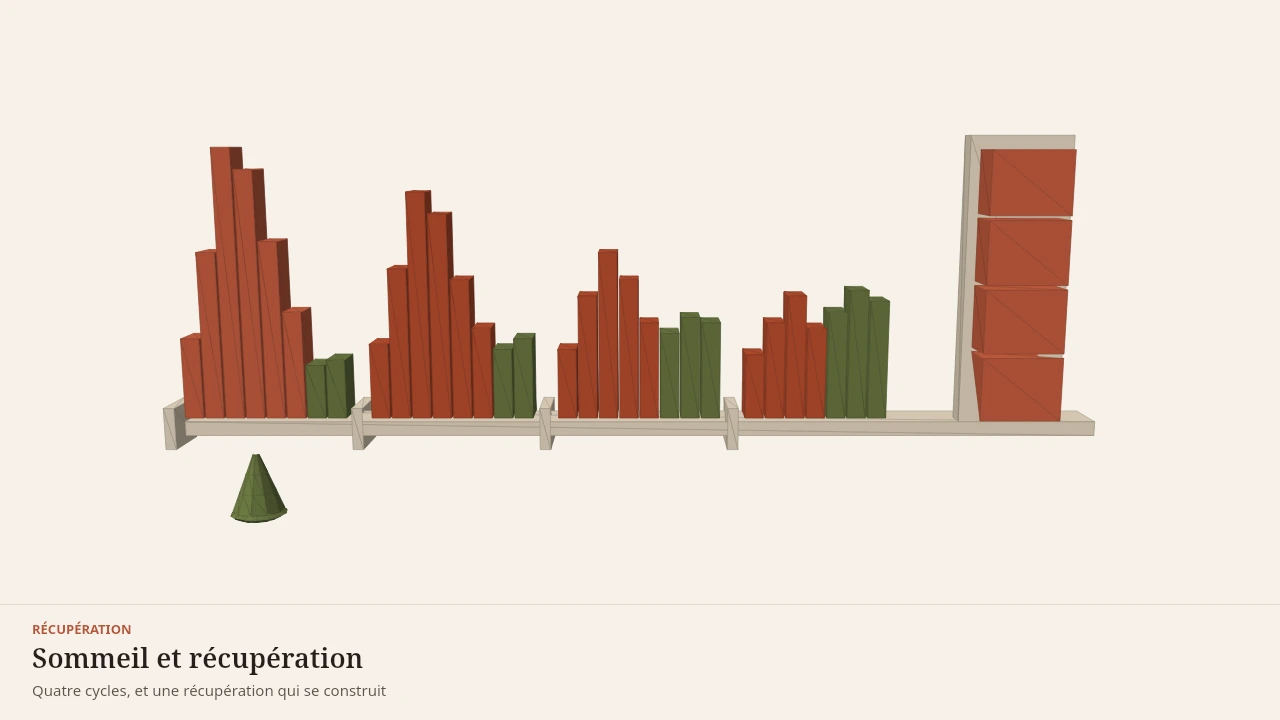
The horizontal axis stands for one night, from falling asleep to waking. It is not uniform: it runs as a series of cycles, drawn here as four groups of blocks separated by tick marks.
Scene description
Bar diagram sitting on a horizontal axis that represents one night, from falling asleep on the left to waking on the right. Four groups of blocks, separated by tick marks, stand for four sleep cycles: within each group, dark blocks rise and then fall — slow-wave sleep, deepest in the middle of the cycle — and end with olive blocks standing for REM sleep. The dark blocks are markedly taller in the first cycle and get lower from cycle to cycle, while the olive blocks become more numerous and taller toward the end of the night. On the right, a framed column fills with four stacked blocks, one per completed cycle: this is accumulated recovery. A cone-shaped marker below the axis points at the current cycle and moves from cycle to cycle. The heights are qualitative and the spacing is even: no duration is measured here.
Visible structures
- Sleep cycleA night runs as a series of cycles. Each one descends into deep slow-wave sleep, comes back up, and ends with a phase of REM sleep.
- Deep slow-wave sleepThe tallest blocks stand for deep slow-wave sleep, concentrated in the early part of the night. It is the portion most closely associated with physical recovery.
- REM sleepThe olive blocks at the end of each cycle stand for REM sleep. Its share grows across the night: it is the portion an early awakening cuts into most.
- Accumulated recoveryThe column gains one block per completed cycle. It is a reminder that recovery accumulates across the night and cannot be made up all at once.
- Axis of the nightThe axis reads left to right, from falling asleep to waking. The tick marks separate the cycles; their even spacing is a reading convenience, not a measured duration.
Guided steps
- 1/5The horizontal axis stands for one night, from falling asleep to waking. It is not uniform: it runs as a series of cycles, drawn here as four groups of blocks separated by tick marks.
- 2/5In the first cycles the dark blocks rise high: this is deep slow-wave sleep. Its share is largest early in the night, then shrinks cycle after cycle.
- 3/5The olive blocks that close each cycle stand for REM sleep. Their number and height increase toward morning: the make-up of the night changes from start to finish.
- 4/5On the right, the column gains one block per completed cycle. Recovery is not a switch: it is built up by successive additions across the whole night.
- 5/5A night cut short mainly removes the final cycles, the ones where REM sleep is most present, and leaves the column incomplete. The cycles lost are not the same as those at the start.
Model licence · Shapier — Propriétaire — usage interne ShapierLab
Caution
When to raise it with a professional
This page describes a general mechanism. It makes no diagnosis, proposes no treatment and does not replace medical advice.
Persistent trouble falling asleep, marked daytime sleepiness, snoring with pauses in breathing or unrefreshing sleep despite adequate duration are matters for a healthcare professional who can examine the person concerned.
Sources for this video
- Fullagar HHK, Skorski S, Duffield R, Hammes D, Coutts AJ, Meyer T (2015). Sleep and athletic performance: the effects of sleep loss on exercise performance, and physiological and cognitive responses to exercise. Sports Medicine.DOI : 10.1007/s40279-014-0260-0
- Hirshkowitz M, Whiton K, Albert SM, et al. (2015). National Sleep Foundation's sleep time duration recommendations: methodology and results summary. Sleep Health.DOI : 10.1016/j.sleh.2014.12.010
Check my understanding
When a night is cut short, what does it mainly lose?
Mostly the end of the night, and with it a large share of REM sleep
A little of each phase, evenly spread
Mainly the deep non-REM sleep of the early night
For which effects of sleep loss are the data clearest?
Prolonged efforts and cognitive functions such as alertness
A single maximal contraction
All types of effort in the same way
What does the 7 to 9 hours of sleep range cited in the video represent?
A range judged appropriate for adults aged 18 to 64 at population level
A personal target to hit every night
A single value valid at any age
Choose an answer
Read next
- Sleep and recoveryWhat does sleep actually do for recovery? This page describes the architecture of a night, what sleep deprivation changes in a documented way, and clearly separates established results from hypotheses that are still open.With a 3D scene
- Muscle protein synthesisWhat happens when muscle manufactures proteins, and is that manufacture enough to predict growth? This page describes the response to exercise and to food, and explains why a single snapshot measurement is so often misleading.With a 3D scene
- Energy and recoveryA six-step reading pathway that follows muscle energy from the second to the night: the instant recharge of ATP, the glycogen stores and their water, then the role of sleep. A closing quiz lets you check what you have taken in.Described without a scene
Put it into practice in Shapier
Planning sessions and rest days
Spreading sessions and rest days across the week is done in Shapier; Body Lab only explains why that spread matters.
Planning sessions and rest days
Body Lab explains; Shapier lets you act and track.
Available offline
Offline download is available in the mobile app.
Trust and method
Author
Editorial review
Thanh Chau
Published on
August 2, 2026
Reviewed on August 2, 2026
Next review due August 2, 2027
Limits of this page
- Much of the available work rests on sleep deprivation induced in a laboratory over a few nights, in young adults: it is a poor description of the chronic sleep shortage of everyday life.
- Duration recommendations are drawn up for whole age brackets and allow for individual variability that their authors acknowledge explicitly.
- The video describes measured associations between sleep and performance; it does not establish that sleep alone explains a change in performance.
Educational content. Body Lab does not diagnose and does not replace professional advice.
How we work