It is the delay that puzzles. The pain is not there at the end of the session: it arrives hours later, peaks the next day or the one after, then fades. That delay alone rules out the most common explanation, without needing any biochemistry.
Why it hurts two days later
Duration: 1:22
Chapters
Transcript
The pain is not there at the end of the session: it arrives hours later, peaks the next day or the one after, then fades. That delay alone rules out the most common explanation.
Lactate builds up during effort and disappears from the circulation within tens of minutes, while soreness peaks one or two days later. The two timelines do not overlap. Lactate is not waste either: it is reused as fuel by muscle, heart and liver.
Braking contractions, where the muscle produces force while lengthening, are what provoke the most delayed soreness: lowering a load, running downhill. How unfamiliar the effort is matters as much as how hard it is, and the exact origin of the pain remains debated.
A painful session is not an effective one, and a pain-free session is not a wasted one: repeating the same work a few weeks later produces far less soreness at the same load. Intense pain, pain in one spot, pain that came on suddenly or with swelling, belongs to a health professional.
What the video shows
The central shot puts two clocks side by side. Lactate builds up during effort and disappears from the circulation within tens of minutes; soreness peaks one or two days later. The two timelines do not overlap.
Lactate
A molecule produced when muscle breaks down carbohydrate faster than oxygen supply allows. Far from being waste, it is reused as fuel by muscle, heart and liver.
lactic acid
Certainty level · Established
Lactate is cleared within tens of minutes after effort stops.
Reviews of energy system interaction describe its production, transport and reuse as fuel. That time course is incompatible with pain that peaks a day or two later, whatever the origin of that pain turns out to be.
Baker JS, McCormick MC, Robergs RA (2010)
What brings it on
The protocols that provoke the most delayed soreness are those that multiply braking contractions: the muscle produces force while lengthening. Lowering a load, running downhill, holding back instead of pulling.
How unfamiliar the effort is matters as much as how hard it is. That is what explains the repeated bout effect: doing the same work again a few weeks later produces far less soreness, at the same load.
Certainty level · Uncertain
The origin of delayed onset muscle soreness is not established.
Several mechanisms are proposed — micro-damage to contractile structures, an inflammatory response, sensitisation of nerve endings — and the available reviews do not settle on one. What is better documented is the association with eccentric contractions, not the causal chain leading to the pain.
Damas F, Phillips SM, Vechin FC, Ugrinowitsch C (2015) · Schoenfeld BJ (2010)
What soreness does not measure
Caution
Neither a marker of effectiveness nor its opposite
A painful session is not an effective one. Reviews of the mechanisms of hypertrophy do not treat pain as an indicator of the adaptive response.
A pain-free session is not a wasted one either: the repeated bout effect removes the pain while the work continues.
When to seek help
Limit
What this video cannot do
It describes a general mechanism and assesses no individual situation. It cannot tell soreness from injury.
Intense pain, pain located at one precise point, pain that appeared suddenly during effort, marked swelling, a pronounced loss of strength, or unusually dark urine call for a health professional, without waiting for the discomfort to pass on its own.
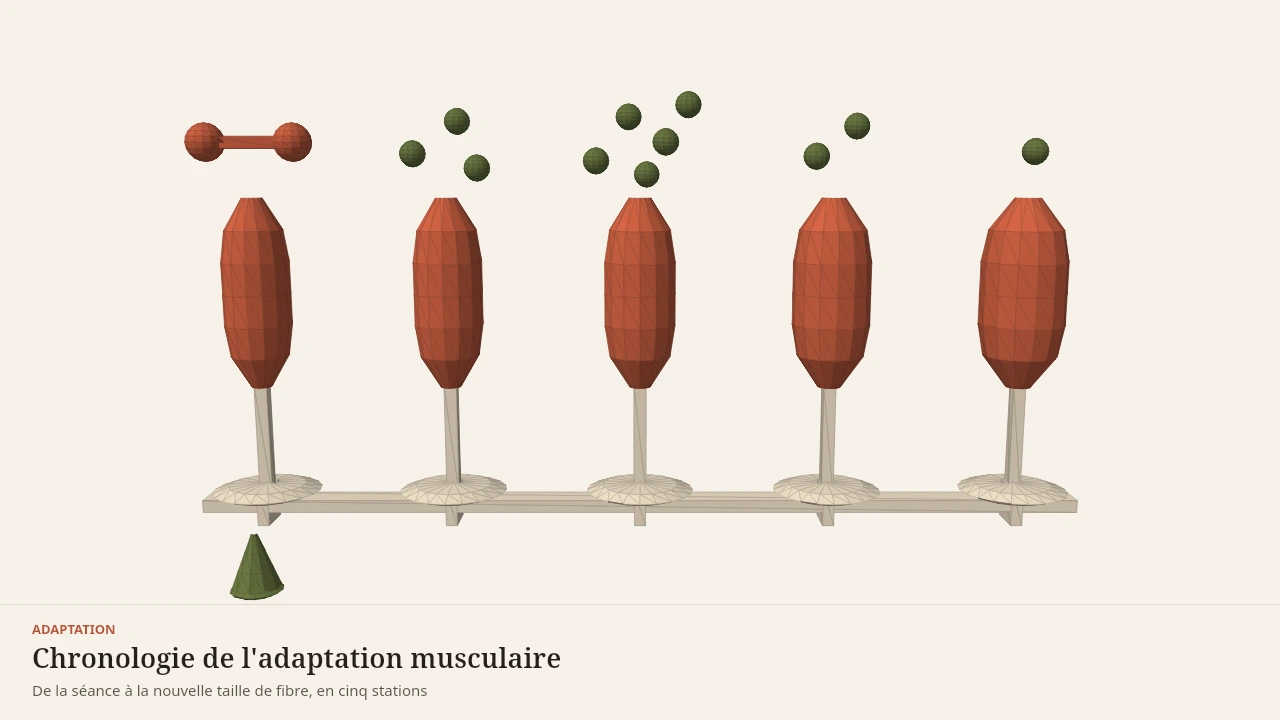
Timeline of muscle adaptation
The scene places delayed soreness in the sequence of events following a session: it occupies the first days, while the structural changes unfold over weeks.
Current step
1. The training session
A demanding enough set puts mechanical tension on the fibres that are working. At this point nothing has changed yet in the structure of the muscle: the session is a signal, not a gain.
Scene description
Timeline diagram: five evenly spaced stations along a horizontal time axis, each topped by a muscle fibre drawn as a vertical capsule. From left to right the stations stand for the training session, the damage and the signalling it triggers, the period of elevated protein synthesis, the remodelling of the fibre, and the new fibre size that results. The capsules grow slightly wider from one station to the next, while a cluster of small spheres above each station shows how intense the signalling is: a schematic dumbbell at the first station, the densest cluster at the third, almost nothing at the fifth. A marker in front of the axis points at the current stage and moves from station to station. The volumes are reading aids: neither the proportions nor the durations are to scale.
Visible structures
- Training sessionA demanding set puts mechanical tension on the fibres that are working. It triggers everything that follows, but it is not yet an adaptation.
- Cellular signalsThe effort disturbs the inside of the fibre and sets off chemical signals. These signals build nothing on their own: they direct what the cell does next.
- Elevated protein synthesisIn response to the signals, the fibre makes proteins faster than it breaks them down. This rise is temporary and settles back toward its usual level.
- New fibre sizeThe cross-section of the fibre only grows through repeated cycles. The diameter shown here is a reading aid, not a measurement.
- Time axisThe axis orders the events from left to right. The intervals are evenly spaced for legibility: they do not represent real durations.
Guided steps
- 1/5A demanding enough set puts mechanical tension on the fibres that are working. At this point nothing has changed yet in the structure of the muscle: the session is a signal, not a gain.
- 2/5The effort disturbs the inside of the fibre and sets off a cascade of chemical signals. They tell the cell to repair and reinforce itself; they do not build any protein on their own.
- 3/5Driven by those signals, the fibre assembles new proteins faster than it breaks them down. This is when the balance turns positive, and the signalling cluster is at its densest here.
- 4/5The new proteins are built into the existing contractile structures. The muscle does not swell all at once: it reorganises itself, and signalling activity subsides.
- 5/5When this cycle repeats regularly, the cross-section of the fibre eventually increases. The visible result is the sum of many tiny adaptations, never the product of a single session.
Model licence · Shapier — Propriétaire — usage interne ShapierLab
Sources
Main sources
- Baker JS, McCormick MC, Robergs RA (2010). Interaction among skeletal muscle metabolic energy systems during intense exercise. Journal of Nutrition and Metabolism.DOI : 10.1155/2010/905612
- Damas F, Phillips SM, Vechin FC, Ugrinowitsch C (2015). A review of resistance training-induced changes in skeletal muscle protein synthesis and their contribution to hypertrophy. Sports Medicine.DOI : 10.1007/s40279-015-0320-0
- Schoenfeld BJ (2010). The mechanisms of muscle hypertrophy and their application to resistance training. Journal of Strength and Conditioning Research.DOI : 10.1519/jsc.0b013e3181e840f3
Put it into practice in Shapier
Plan recovery weeks in Shapier
Planning a lighter week when fatigue builds up is done in Shapier; Body Lab only explains what soreness measures, and what it does not.
Plan recovery weeks in Shapier
Body Lab explains; Shapier lets you act and track.
Read next
- Delayed muscle sorenessThe ache that arrives the next day is not lactic acid. What is known about where it comes from, how it runs its course, and why it measures neither the quality nor the value of a session.With a 3D scene
- Sleep and recoveryWhat does sleep actually do for recovery? This page describes the architecture of a night, what sleep deprivation changes in a documented way, and clearly separates established results from hypotheses that are still open.With a 3D scene
- Mechanical tension, fatigue and volumeShould you lift heavy, train to exhaustion, or simply do a lot? This page untangles three variables that are often confused, shows how they combine over the course of a set, and states the level of evidence behind each one.With a 3D scene
Available offline
Offline download is available in the mobile app.
Trust and method
Author
Editorial review
Thanh Chau
Published on
August 2, 2026
Reviewed on August 2, 2026
Next review due August 2, 2027
Limits of this page
- The exact origin of delayed soreness is not established: several mechanisms are proposed and none accounts on its own for all the observations.
- The timings shown describe an average trend across published protocols, not what any given person will feel.
- This video assesses no individual's pain: it cannot tell soreness from injury.
- Intense pain, pain in one precise spot, pain that appeared suddenly during effort, or pain with swelling or dark urine calls for a health professional without delay.
Educational content. Body Lab does not diagnose and does not replace professional advice.
How we work