What the vertical pull is for
The vertical pull brings the arm back towards the trunk from a position above the head: hauling yourself onto a ledge, taking a box down from a high shelf, climbing. The elbow travels down and flexes while the shoulder blade rotates downwards and depresses.
It is the reverse movement of the vertical push. It comes in two mechanically distinct configurations: the pull-up, in which the hands are fixed and the body moves, and the pulldown, in which the body is fixed and the load moves. The joint sequence is the same, the base of support and the load to overcome are not (neumann2016).
Downward rotation of the shoulder blade
Rotation of the shoulder blade that turns the glenoid cavity back downwards. It accompanies the descent of the arm from a raised position and constitutes the scapular component of the vertical pull.
scapular downward rotation · medial rotation of the scapula
The phases of the movement
The vertical pull, phase by phase
- 1Hanging or top positionbefore the pullThe arms are above the head, the shoulder blade in upward rotation. The trunk muscles contract to stop the lumbar spine extending during the effort.
- 2Initial concentric phasestartThe shoulder blade begins its downward rotation and depression. The movement starts at the shoulder girdle before it becomes visible at the elbow.
- 3Main concentric phasepullingThe shoulder brings the arm towards the trunk, the elbow flexes and travels down. This is the portion where the demand on the adductors and extensors of the arm is greatest.
- 4End of the pullelbows alongside the trunkThe range ends when the shoulder blade has completed its rotation. Continuing beyond that amounts to twisting the trunk rather than moving the shoulder.
- 5Eccentric phasereturnThe path is retraced under control: the muscles lengthen while producing force and the shoulder blade returns to upward rotation.
Joints and planes of movement
- Glenohumeral: the arm comes back towards the trunk through a combination of adduction and
extension, whose proportions depend on the width of the grip.
- Scapulothoracic: the shoulder blade rotates downwards and depresses. Without that rotation,
the arm could not come back down alongside the body.
- Sternoclavicular and acromioclavicular: they accompany the depression of the clavicle and
the shoulder blade.
- Elbow and radioulnar: elbow flexion is constant; the orientation of the forearm changes the
contribution of the different flexors (neumann2016).
- Lumbar spine: it is held, particularly in the pull-up, where body weight tends to produce a
compensatory extension.
The movement takes place mainly in the frontal plane, the one that separates the front and the back of the body, with a sagittal component that is more marked the narrower the grip.
Who does the work
Muscle roles in the vertical pull
Role
Main structures
What they do
Prime movers
Latissimus dorsi, teres major, sternocostal head of the pectoralis major
Bring the arm back towards the trunk from the top position, in adduction and extension.
Synergists
Rhomboids, lower trapezius, pectoralis minor, biceps brachii, brachialis
Rotate the shoulder blade downwards, depress it and flex the elbow.
Stabilisers
Rotator cuff, abdominal wall, glutes
Centre the humeral head and stop the pelvis and the spine compensating.
The teres major deserves a mention of its own: running from the shoulder blade to the humerus, it accompanies the latissimus dorsi in almost all its actions on the arm, to the point of sometimes being described as its assistant. It has, on the other hand, no attachment to the trunk, which clearly distinguishes their respective roles (standring2020).
Certainty level · Established
The pectoralis major takes part in the vertical pull: its sternocostal head is a powerful adductor of the arm when the arm starts from a raised position.
Descriptive anatomy attributes to this head, running from the sternum and the costal cartilages to the humerus, an action of adduction and extension of the arm from a raised position — exactly the path travelled during a vertical pull. The practical consequence is that a vertical pull cannot be presented as a “back” movement in the strict sense. The actual share of each muscle during a repetition nevertheless remains hard to quantify: surface electromyography does not clearly separate neighbouring or deep muscles, and measured values vary considerably between protocols.
Neumann DA (2016) · Standring S (2020)
Morphological and technical variations
Grip width changes the proportion between adduction and extension at the shoulder, as well as the length of the lever arm at the elbow. A wide grip emphasises the adduction component in the frontal plane; a narrow grip brings the movement closer to a pure extension and lengthens the path travelled by the elbow (neumann2016).
The orientation of the grip acts on the elbow flexors: the biceps brachii is most effective with the forearm supinated, the brachialis works whatever the orientation, and the brachioradialis is called on most in a neutral position (neumann2016). The range that can be reached overhead, lastly, varies from one person to another. Work carried out in recreational weight training participants described in that population differences in mobility and strength between the rotators of the shoulder (kolber2009): a cross-sectional finding, which points to no cause, but which illustrates the variability of the ranges observed.
Common misunderstandings
Caution
Three misconceptions about the vertical pull
“The vertical pull widens the back, the horizontal pull thickens it.” The direction of a movement changes the relative demand on the muscles, it does not determine a shape of growth. A muscle that grows increases its cross-sectional area, it does not choose a direction of expansion according to the exercise.
“A wide grip works the latissimus dorsi more.” Grip width changes joint angles and lever arms, it does not switch one muscle on rather than another.
“The chin has to clear the bar for the repetition to count.” That marker is a counting criterion, not a biomechanical fact. The range actually available depends on the shoulder and the shoulder blade, not on the position of the head.
A fourth confusion sets the pull-up and the pulldown against each other as though they were two different movements. The joint sequence is the same: what changes is the load to be moved, set by body mass in one case and adjustable in the other, along with the trunk stabilisation demand, which is higher when hanging.
Latissimus dorsi and pulling
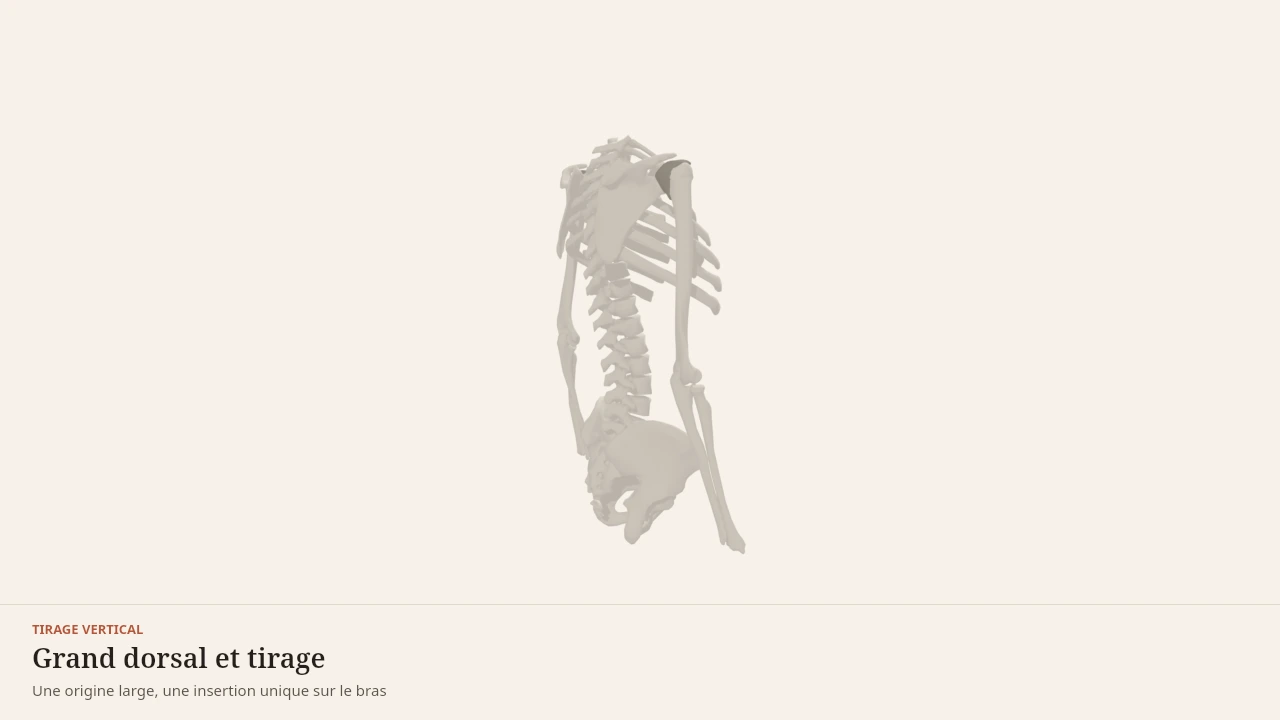
The model shows the latissimus dorsi and the teres major during the descent of the arm from a raised position, together with the rotation of the shoulder blade that accompanies it. The text stays complete without the scene, which illustrates a reference arrangement and not the morphology of a real person.
Current step
Three parts to connect
A pull connects the hand to the pelvis through three moving parts: the humerus, the shoulder blade gliding over the ribcage, and the spine acting as the fixed point. Latissimus dorsi is the only muscle to span almost that whole path, from pelvis to arm.
Scene description
A three-dimensional diagram of the trunk seen from behind, arms raised diagonally overhead as at the start of a vertical pull. The ribcage, the spine, the pelvis, both shoulder blades, both humeri and the forearms are shown in bone tones, with a small dark sphere marking each shoulder joint. In terracotta, latissimus dorsi forms a wide fan on each side, spreading from the lower back and iliac crest and narrowing as it rises to the top of the humerus. The trapezius is split into three bands — upper towards the shoulder, middle towards the spine of the scapula, lower rising from the mid back — and biceps brachii runs along the front of the arm. A two-and-a-half-second animation brings the humeri back alongside the trunk in adduction while the shoulder blades descend and latissimus dorsi shortens. The volumes are stylised: this is a teaching diagram, not an exact anatomical reconstruction.
Visible structures
- Latissimus dorsiA broad fan arising from the spinous processes of the lower thoracic and lumbar vertebrae, the thoracolumbar fascia, the iliac crest and the last three or four ribs. All its fibres converge on the bicipital groove of the humerus: it pulls the arm down, back and towards the trunk.
- Shoulder bladeA flat bone gliding over the back of the ribcage, with no direct joint to the spine. In a pull it depresses and rotates downwards: without that motion the humerus jams against the acromion and the range gets paid for elsewhere.
- TrapeziusIts three portions pull the shoulder blade in three directions: the upper elevates it, the middle draws it towards the spine, the lower depresses it. In a vertical pull, the lower portion is the direct partner of latissimus dorsi.
- Biceps brachiiTwo heads arising from the scapula and inserting on the radial tuberosity. It flexes the elbow and supinates the forearm: in a pull it shortens the distance between hand and shoulder while latissimus dorsi moves the arm.
- Insertion on the humerusThe tendon of latissimus dorsi attaches in the floor of the bicipital groove, at the very top of the humerus. A wide origin across the whole lower back and a narrow insertion high on the arm: that convergence is what gives the muscle its fan shape.
Guided steps
- 1/5A pull connects the hand to the pelvis through three moving parts: the humerus, the shoulder blade gliding over the ribcage, and the spine acting as the fixed point. Latissimus dorsi is the only muscle to span almost that whole path, from pelvis to arm.
- 2/5Latissimus dorsi anchors across almost the whole lower back: the lower thoracic and lumbar spinous processes, the thoracolumbar fascia, the iliac crest and the lowest ribs. That origin surface is what gives it its strength, and why a pull is felt all the way down to the pelvis.
- 3/5All those fibres converge into a flat tendon attached in the floor of the bicipital groove of the humerus. Wide below, narrow above: the pull concentrates on a single point of the arm, which makes it strongly directional — downwards and backwards.
- 4/5The humeri leave the overhead position and adduct back alongside the trunk while the shoulder blades depress and rotate downwards. Latissimus dorsi shortens, the lower trapezius holds the blade down and the elbow bends: arm motion and shoulder-blade motion cannot be separated.
- 5/5The lower trapezius depresses the shoulder blade, the middle trapezius draws it towards the spine, and biceps brachii flexes the elbow to bring the hand closer to the shoulder. A pull is never an isolated back exercise: it is coordination between arm, shoulder blade and spine.
Model licence · Z-Anatomy et BodyParts3D — CC-BY-SA 4.0
The vertical pull complements the vertical push, which retraces the same path in the opposite direction, and differs from the horizontal pull in the orientation of the arm and in the direction of shoulder blade rotation.
The pages devoted to the latissimus dorsi, the biceps brachii and the trapezius detail the structures cited here. On the question of muscle growth raised above, see how muscle grows.
Key sources
- Neumann DA (2016). Kinesiology of the Musculoskeletal System: Foundations for Rehabilitation, 3rd edition. Elsevier.https://shop.elsevier.com/books/kinesiology-of-the-musculoskeletal-system/neumann/978-0-323-28753-1
- Standring S (2020). Gray's Anatomy: The Anatomical Basis of Clinical Practice, 42nd edition. Elsevier.https://shop.elsevier.com/books/grays-anatomy/standring/978-0-7020-7705-0
- Kolber MJ, Beekhuizen KS, Cheng MS, Hellman MA (2009). Shoulder joint and muscle characteristics in the recreational weight training population. Journal of Strength and Conditioning Research.DOI : 10.1519/jsc.0b013e31818eafb4
Put it into practice in Shapier
See the pull-up exercise
The pull-up page in Shapier details the setup and execution of this vertical pull exercise, to move from the description of the movement to its practice.
See the pull-up exercise
Body Lab explains; Shapier lets you act and track.
Check my understanding
What actually distinguishes the pull-up from the lat pulldown?
The load to be moved and the trunk stabilisation demand
The joint sequence, which differs from one exercise to the other
The direction of shoulder blade rotation
What does a wide grip on a vertical pull really change?
Joint angles and lever arms
It works the latissimus dorsi more
It lengthens the path travelled by the elbow
Why is “the chin must clear the bar” not a sound repetition criterion?
Because it is a counting criterion, not a biomechanical fact
Because the chin always clears the bar when the pull is complete
Because aiming at the bar with the chin tires the elbow flexors more
Choose an answer
Read next
- Horizontal pullThe horizontal pull brings the hands towards the trunk along an axis perpendicular to it. This page describes its phases, the shoulder, shoulder blade and elbow joints, the muscles involved and the most frequent confusions about it.With a 3D scene
- Vertical pushThe vertical push takes the hand above the head. This page describes its phases, the coordination between the shoulder and the shoulder blade, the prime movers and stabilisers, and the most widespread confusions about overhead movements.With a 3D scene
- Latissimus dorsiThe latissimus dorsi is the broadest muscle of the back. It links the pelvis and the spine to the humerus, and draws the arm down and backward in every pulling movement.With a 3D scene
- How muscle growsWhat actually makes a muscle grow? This page follows the chain of events that links a set of exercise to a thicker muscle fibre, and separates what is established from what is still debated by research.With a 3D scene
Available offline
Offline download is available in the mobile app.
Trust and method
Author
Editorial review
Thanh Chau
Published on
August 2, 2026
Reviewed on August 2, 2026
Next review due August 2, 2027
Limits of this page
- The description corresponds to a symmetrical, controlled pull; a pull-up launched with help from the legs or the hips adds a trunk movement component that this page does not detail.
- The range that can be reached overhead depends on the orientation of the glenoid cavity, the mobility of the thoracic spine and the extensibility of the tissues, all highly variable between people.
- This page explains a movement, it assesses no individual execution: shoulder or elbow pain that persists, or discomfort that appears at every repetition, is a matter for a healthcare professional.
Educational content. Body Lab does not diagnose and does not replace professional advice.
How we work