What the horizontal push is for
The horizontal push is the movement in which the hands travel away from the trunk along an axis perpendicular to it: pushing a heavy door open, moving an object away in front of you, getting up off the floor from a plank position. The arm travels forward in front of the body while the elbow extends.
It belongs to a family of movements defined by a direction, not by a piece of equipment. The bench press, push-ups and a cable press share the same joint organisation; what changes is the position of the trunk and whether or not the shoulder blade can move on the ribcage (neumann2016).
Horizontal adduction
Movement in which the arm, already away from the body, comes back towards the midline by passing in front of the trunk. It is the main component of the horizontal push at the shoulder joint.
horizontal flexion of the shoulder
The phases of the movement
The horizontal push, phase by phase
- 1Set-upbefore the descentThe shoulder blades settle on the ribcage, the feet and trunk take support, and the breath is briefly held to stiffen the trunk.
- 2Eccentric phaseloweringThe elbow flexes and the arm travels progressively backwards. The pushing muscles lengthen while producing force and slow the movement.
- 3Transitionend of rangeThe movement reverses. The prime movers at the shoulder are in their most lengthened position and the shoulder blade stabilisers work to keep it in contact with the ribcage.
- 4Concentric phasepushingThe shoulder brings the arm forward and the elbow extends. The shoulder blade follows the movement by sliding forward on the ribcage.
- 5End of the pusharms extendedElbow extension is completed and the position of the shoulder blade stabilises before the next repetition.
Joints and planes of movement
Three joints and one sliding surface take part in the movement.
- Glenohumeral: a ball-and-socket joint between the humeral head and the glenoid cavity. It
produces horizontal adduction and part of the flexion of the arm. Its articular surface is shallow, which explains its large range of motion and the central role of the muscles in keeping it centred (standring2020).
- Scapulothoracic: strictly speaking this is not a joint but a sliding plane between the
shoulder blade and the ribcage. The shoulder blade travels forward there during the push.
- Elbow: a hinge joint; extension there accompanies the action of the shoulder.
- Sternoclavicular and acromioclavicular: they allow the movements of the clavicle that make
movement of the shoulder blade possible (neumann2016).
The movement combines the transverse plane — horizontal adduction, visible from above — and the sagittal plane when the arm passes in front of the body.
Who does the work
Muscle roles in the horizontal push
Role
Main structures
What they do
Prime movers
Pectoralis major, anterior deltoid, triceps brachii
Bring the arm towards the midline in front of the trunk and extend the elbow.
Synergists
Serratus anterior, coracobrachialis
Draw the shoulder blade forward on the ribcage and assist flexion of the arm.
Stabilisers
Rotator cuff, abdominal wall, glutes
Keep the humeral head centred and give the trunk a stable base.
The pectoralis major does not act as a single block. Its clavicular head, running from the clavicle to the humerus, contributes more when the arm pushes upwards and forwards; its sternocostal head, which is larger, acts mainly along a horizontal or downward axis (standring2020). The direction of the push therefore changes the share taken by each.
The trunk and the lower limbs are not spectators. The force produced by the arms is transmitted through a trunk stiffened by the simultaneous contraction of the abdominal and lumbar muscles: an unstable base reduces the force available at the extremities (mcgill2010).
Certainty level · Established
Movement of the arm does not come from the shoulder joint alone: the shoulder blade moves at the same time on the ribcage.
This coordination, known as scapulohumeral rhythm, is classically described as a total arm elevation of about 180 degrees, of which about 120 come from the glenohumeral joint and about 60 from movement of the shoulder blade, a ratio close to two to one. That ratio is a descriptive average: it varies with the load, the range and the individual, and it is not constant throughout the movement.
Neumann DA (2016) · Standring S (2020)
Morphological and technical variations
Hand spacing changes the relative contribution of the shoulder and the elbow: the wider the hands, the more the range comes from horizontal adduction; the closer they are, the greater the share of elbow extension (neumann2016).
The inclination of the trunk changes the axis of the push and therefore the share taken by the heads of the pectoralis major and by the anterior deltoid. The support matters too: lying on a bench, the shoulder blade is partly blocked by the supporting surface, whereas with support on the floor it stays free to slide on the ribcage. The observable movement is similar, the muscular organisation is not.
Caution
Three misconceptions about the horizontal push
“The horizontal push is a chest exercise.” The pectoralis major is a prime mover there, but the anterior deltoid, the triceps brachii and the serratus anterior take part in the same action. A push does not isolate a muscle.
“The bigger the range, the better.” The usable range depends on the mobility available at the shoulder, which itself varies with the orientation of the glenoid and the flexibility of the tissues. A range of motion is not better in absolute terms.
“A painful shoulder is fixed by changing the exercise.” Watching something on a screen does not replace an examination. Pain that persists is a reason to consult, not a problem of exercise selection.
A fourth confusion consists in believing that pushing and pulling balance each other out automatically. A study carried out in recreational weight training participants described differences in mobility and strength between internal and external rotators of the shoulder in that population (kolber2009). This cross-sectional finding does not demonstrate a cause-and-effect relationship with any type of exercise, but it is a reminder that balance between movement families is not obtained by default.
Pectoralis major and pushing
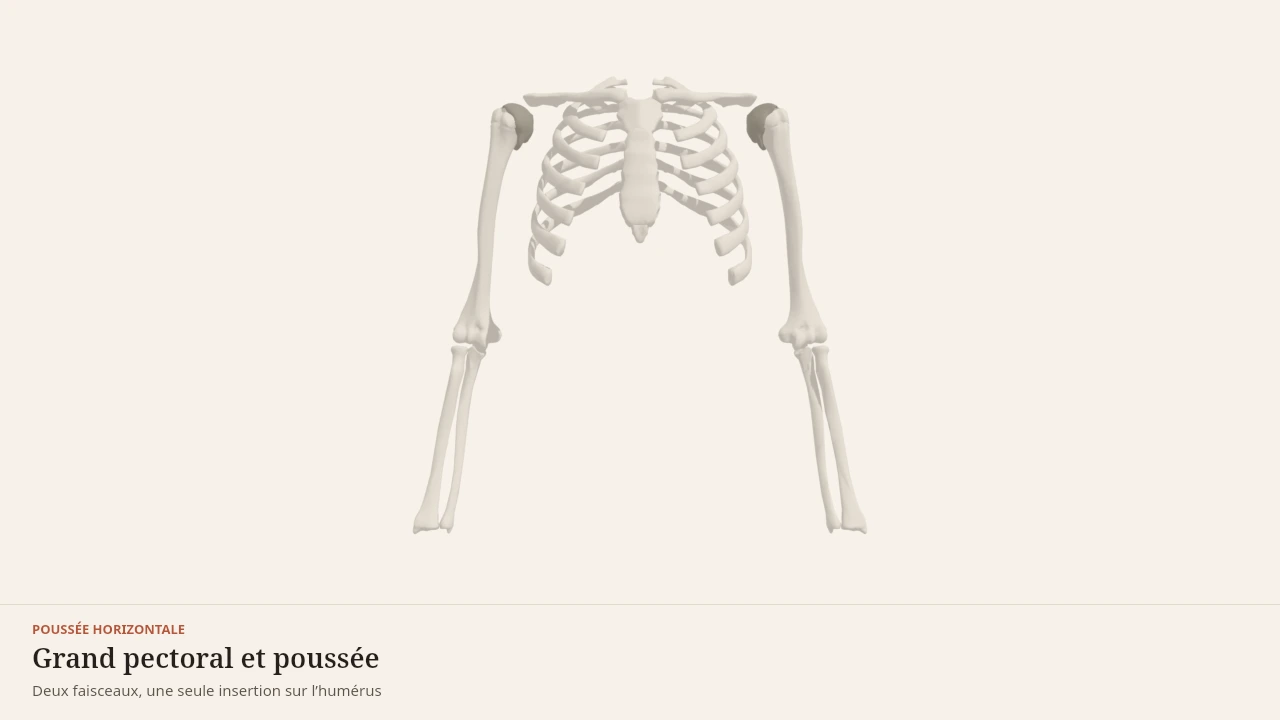
The model shows the pectoralis major, the anterior deltoid and the triceps during the out-and-back of a push, together with the movement of the shoulder blade on the ribcage. The text stays complete without the scene, which illustrates a general organisation and not an individual morphology.
Current step
The frame of the push
Pectoralis major does not pull into thin air: it links a wide fixed base — clavicle, sternum and costal cartilages — to a single moving point on the humerus. Locating those bony attachments is already enough to understand its line of pull.
Scene description
A three-dimensional diagram of the upper trunk seen from the front, both arms held out horizontally as at the start of a bench press. The ribcage, sternum, both clavicles, both humeri and the forearms are shown in bone tones, and each shoulder joint is marked by a small dark sphere. Over this frame, pectoralis major is laid out in terracotta as two distinct heads: a thin clavicular head under the collarbone, and a much broader sternocostal head running from the sternum to the humerus, both converging on the same insertion point. The anterior deltoid caps the front of the shoulder and triceps brachii runs along the back of the arm. An animation brings the humeri in front of the chest in horizontal adduction while the belly of pectoralis major thickens. The volumes are deliberately simplified: this is a teaching diagram, not an exact anatomical reconstruction.
Visible structures
- Clavicular headThe thin upper portion of pectoralis major, arising from the medial third of the front of the clavicle. Its fibres run down to the humerus, carrying the arm forwards and upwards, and it dominates in incline pushing.
- Sternocostal headThe broad lower portion, arising from the lateral border of the sternum and the cartilages of the first six ribs. Its fibres run obliquely up to the bicipital groove of the humerus, bringing the arm forwards and downwards.
- Humeral insertionBoth heads converge into a flat tendon attached to the lateral lip of the bicipital groove of the humerus. The whole origin — clavicle, sternum and ribs — therefore pulls on this single point, which is what makes the line of pull so directional.
- Anterior deltoidThe front head of the deltoid, arising from the lateral third of the clavicle and inserting on the deltoid tuberosity. It flexes the shoulder and carries the arm forwards, working alongside pectoralis major in every push.
- Triceps brachiiThree heads joining on the olecranon of the ulna. It extends the elbow and finishes the push: without it the arm closes towards the trunk but the load never actually travels away.
Guided steps
- 1/5Pectoralis major does not pull into thin air: it links a wide fixed base — clavicle, sternum and costal cartilages — to a single moving point on the humerus. Locating those bony attachments is already enough to understand its line of pull.
- 2/5The upper portion arises from the medial third of the clavicle. Its fibres run obliquely downwards to the humerus, which gives them a flexing action: they carry the arm forwards and upwards, and dominate in incline pushing.
- 3/5The much broader lower portion arises from the sternum and the cartilages of the first six ribs. Its fibres run upwards to the humerus, bringing the arm forwards and downwards — the direction of the bench press and the push-up.
- 4/5When the arm starts out to the side and comes back in front of the chest, pectoralis major shortens and its belly thickens. This horizontal adduction is the movement it produces most efficiently, and it sits at the heart of every horizontal push.
- 5/5The anterior deltoid carries the arm forwards, and triceps brachii extends the elbow to finish the movement. None of the three is enough on its own: a horizontal push is always teamwork, which is why fatigue in a single link ends the set.
Model licence · Z-Anatomy et BodyParts3D — CC-BY-SA 4.0
The horizontal push forms a functional pair with the horizontal pull, which moves the load in the opposite direction, and differs from the vertical push in the orientation of the arm and the extent of shoulder blade rotation.
The pages devoted to the pectoralis major, the deltoids and the triceps brachii detail the structures cited here.
Key sources
- Neumann DA (2016). Kinesiology of the Musculoskeletal System: Foundations for Rehabilitation, 3rd edition. Elsevier.https://shop.elsevier.com/books/kinesiology-of-the-musculoskeletal-system/neumann/978-0-323-28753-1
- Standring S (2020). Gray's Anatomy: The Anatomical Basis of Clinical Practice, 42nd edition. Elsevier.https://shop.elsevier.com/books/grays-anatomy/standring/978-0-7020-7705-0
- Kolber MJ, Beekhuizen KS, Cheng MS, Hellman MA (2009). Shoulder joint and muscle characteristics in the recreational weight training population. Journal of Strength and Conditioning Research.DOI : 10.1519/jsc.0b013e31818eafb4
- McGill SM (2010). Core training: evidence translating to better performance and injury prevention. Strength and Conditioning Journal.DOI : 10.1519/ssc.0b013e3181df4521
Put it into practice in Shapier
See the push-up exercise
Follow in Shapier the step-by-step push-up, an exercise from the horizontal push family, to prepare your next session.
See the push-up exercise
Body Lab explains; Shapier lets you act and track.
Check my understanding
Is the horizontal push an exercise that isolates the chest?
No, the pectoralis major is a prime mover but the anterior deltoid, the triceps brachii and the serratus anterior take part in the same action
Yes, it is the reference exercise for targeting the pectoralis major alone
Yes, provided the hands are placed wider apart
Do the bench press and push-ups have the same muscular organisation because the observable movement is similar?
No, lying on a bench the shoulder blade is partly blocked whereas with support on the floor it stays free to slide on the ribcage
Yes, both belong to the horizontal push family so everything is identical
Yes, only the inclination of the trunk distinguishes the two exercises
What should we make of the two-to-one ratio of the scapulohumeral rhythm?
It is a descriptive average, which varies with the load, the range and the individual
It is a constant mechanical law, valid for any elevation of the arm
It is a ratio that only concerns the eccentric phase of the push
Choose an answer
Read next
- Horizontal pullThe horizontal pull brings the hands towards the trunk along an axis perpendicular to it. This page describes its phases, the shoulder, shoulder blade and elbow joints, the muscles involved and the most frequent confusions about it.With a 3D scene
- Vertical pushThe vertical push takes the hand above the head. This page describes its phases, the coordination between the shoulder and the shoulder blade, the prime movers and stabilisers, and the most widespread confusions about overhead movements.With a 3D scene
- Pectoralis majorThe pectoralis major covers the front of the chest and draws the arm toward the midline. It is the main driver of horizontal pushing and contributes to internal rotation of the shoulder.With a 3D scene
- Triceps brachiiThe triceps brachii fills the whole back of the upper arm and extends the elbow. Its long head also crosses the shoulder, which changes its length depending on the position of the arm.With a 3D scene
Available offline
Offline download is available in the mobile app.
Trust and method
Author
Editorial review
Thanh Chau
Published on
August 2, 2026
Reviewed on August 2, 2026
Next review due August 2, 2027
Limits of this page
- The muscle roles described correspond to a symmetrical push performed at a controlled speed along an axis close to the horizontal; an explosive, inclined or single-arm push distributes the loading differently.
- The orientation of the glenoid cavity, the shape of the acromion and the distribution of the heads of the pectoralis major vary from one person to another: the model illustrates a general organisation.
- This page explains a movement, it assesses no execution: shoulder pain that persists, wakes you at night or limits everyday actions is a matter for a healthcare professional.
Educational content. Body Lab does not diagnose and does not replace professional advice.
How we work