Why does water matter so much during effort?
Water makes up most of the body's mass, and muscle holds a higher proportion than average. It is not stored there passively: it fills three distinct roles, and it is their sum that explains why a moderate loss gets noticed.
Key point
The answer in three sentences
Water forms the liquid part of the blood, the part that carries oxygen and fuel to the muscle. It also serves to carry heat away, through sweating. And it accompanies glycogen storage, each unit stored holding several times its own weight in water.
Losing water therefore touches transport, cooling and reserves all at once.
First role: carrying the blood
Plasma volume
The volume of the liquid fraction of blood, in which the blood cells travel. It falls when the body loses water, which reduces how much blood the heart can move with each beat.
the liquid part of blood
Muscle makes no energy without supply: the aerobic system needs oxygen, and that oxygen arrives by blood. When plasma volume drops, the heart has to beat faster to keep the same output. That is the most direct mechanism by which losing water turns into a higher sense of effort at the same pace.
Second role: carrying heat away
A muscle contraction turns only a fraction of the energy it consumes into movement; the rest becomes heat. The body sheds it mainly by evaporating sweat from the surface of the skin — a mechanism that spends water.
A difficulty then appears: in the heat, blood is called on for two tasks at once. It has to supply the muscle with oxygen and reach the skin to deposit heat there. Those two needs compete, and it is that sharing, more than temperature alone, that makes effort harder when it is hot.
Third role: accompanying glycogen
The page on muscle glycogen describes that store and the water that comes with it. The link works both ways: rebuilding reserves after an effort means rebuilding the water that goes with them.
Certainty level · Probable
Rebuilding muscle glycogen after prolonged effort is accompanied by a rebuilding of muscle water.
The study uses prolonged efforts performed in the heat by healthy adults, with direct measurement in the muscle. The number of participants is small and the conditions are those of a laboratory; the exact ratio between glycogen and water retained varies between studies and measurement methods.
Fernández-Elías VE, Ortega JF, Nelson RK, Mora-Rodriguez R (2015)
Timeline of a prolonged effort in the heat
What becomes of water during effort
- 1Start0 minPlasma volume is at its usual level; heat production begins to climb.
- 2Sweating startsa few minutesEvaporation begins carrying heat away, at the cost of a continuous water loss.
- 3Competing needssteady effortBlood is shared between muscle and skin; heart rate climbs at a constant pace.
- 4After the efforthoursRebuilding glycogen stores is accompanied by a rebuilding of muscle water.
Seeing the link between water and reserves
Glycogen storage and use
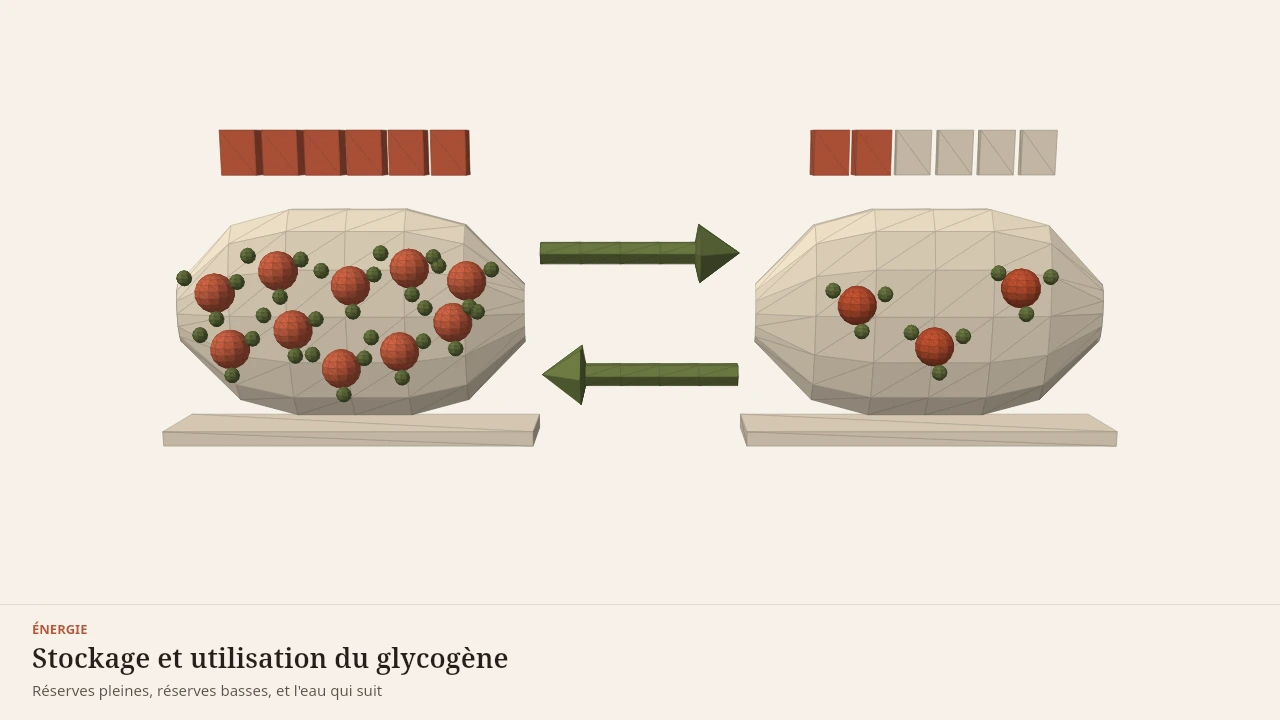
The scene shows glycogen stored in the muscle fibre. The water that comes with it is not drawn there, but it explains part of what the scales show after a long effort. Without the 3D, the idea fits in one sentence: storing glycogen also means holding water.
Current step
1. The store inside the fibre
On the left, a muscle fibre opened along its length. The dark spheres spread inside stand for glycogen granules, the form in which muscle stores carbohydrate.
Scene description
Comparative diagram: two identical muscle fibres, opened lengthwise like slices, sit side by side on pale plinths. The left one, with full stores, holds about ten dark spheres — the glycogen granules — each ringed by three small spheres standing for the water stored with it; above it, a six-segment gauge is completely filled. The right one, with low stores, holds only three granules and their water, and its gauge shows just two solid segments followed by four hollow ones. Between the two fibres, an upper arrow pointing right represents the effort that empties the store, and a lower arrow pointing left represents the dietary refuelling that rebuilds it. Sizes and counts are symbolic: nothing here is to scale.
Visible structures
- Glycogen granuleGlycogen is the form in which muscle stores carbohydrate. It is gathered into granules spread through the fibre, ready to be mobilised quickly during effort.
- Associated waterGlycogen is stored together with water, shown here as the small satellite spheres. When the store falls, that water leaves with it and the number on the scale follows, which says nothing about fat mass.
- Fibre in sectionThe fibre is drawn as a slice, as if it had been opened along its length. The section only serves to show what it contains.
- Low storesAfter a long effort, few granules are left. The fibre still works, but the intensity it can sustain drops.
- RefuellingDietary carbohydrate rebuilds glycogen, and the associated water comes back with it. This is one of the reasons the number on the scale moves from one day to the next.
Guided steps
- 1/5On the left, a muscle fibre opened along its length. The dark spheres spread inside stand for glycogen granules, the form in which muscle stores carbohydrate.
- 2/5Each granule is ringed by small spheres: the water stored alongside it. Glycogen and water travel together, which explains part of the day-to-day swings on the scale.
- 3/5During sustained effort the fibre breaks down its glycogen to produce energy. The upper arrow shows the move from one state to the other, and the group of granules shrinks.
- 4/5On the right, the same fibre after the effort: few granules, little associated water, an almost empty gauge. The number on the scale has dropped, but that particular drop comes from glycogen and its water, not from fat mass.
- 5/5Dietary carbohydrate rebuilds the store and the water returns with it: the lower arrow brings the fibre back to its full state. This back-and-forth repeats continuously, independently of fat mass.
Model licence · Shapier — Propriétaire — usage interne ShapierLab
What this page does not say
Limit
No amounts, no rules
Body Lab describes mechanisms, not conduct. Water losses depend on the person, the heat, the humidity, the duration and the intensity, and vary by a wide margin between individuals. No general amount would mean anything here, and giving one would be personalised advice.
The figures often quoted in general recommendations come from laboratory protocols, in the heat, on small numbers of people. They describe a studied population, not any particular reader.
Unusual thirst, feeling faint during effort, or an unexplained change in weight call for a health professional.
Three common misreadings
Caution
What you often hear
That thirst comes too late. The claim circulates widely; the available work does not settle it in general terms, and its reach depends heavily on context.
That weight lost during a session is fat. A large part of it is water, regained as soon as reserves are rebuilt. The page on glycogen covers this.
That drinking more improves performance. Nothing in the mechanisms described here supports that: they explain what losing water degrades, not what an excess would add.
Sources
Main sources
- Fernández-Elías VE, Ortega JF, Nelson RK, Mora-Rodriguez R (2015). Relationship between muscle water and glycogen recovery after prolonged exercise in the heat in humans. European Journal of Applied Physiology.DOI : 10.1007/s00421-015-3175-z
- Burke LM, Hawley JA, Wong SHS, Jeukendrup AE (2011). Carbohydrates for training and competition. Journal of Sports Sciences.DOI : 10.1080/02640414.2011.585473
- Gastin PB (2001). Energy system interaction and relative contribution during maximal exercise. Sports Medicine.DOI : 10.2165/00007256-200131100-00003
Put it into practice in Shapier
Plan sessions and rest days
Spreading sessions and rest days across the week happens in Shapier; Body Lab only explains why that distribution matters.
Plan sessions and rest days
Body Lab explains; Shapier lets you act and track.
Check my understanding
When plasma volume drops, what does the page describe at the same pace?
The heart beats faster to keep the same output, and effort feels harder
The muscle stops receiving oxygen
Sweating stops to save water
Why is effort harder in the heat, according to the page?
Because blood is shared between supplying the muscle and reaching the skin to deposit heat
Because the outside temperature fully explains the difficulty
Because heart rate drops to protect the body
Is weight lost during a session fat?
No, a large part of it is water, regained as soon as reserves are rebuilt
Yes, since effort draws on the body's reserves
Yes, but only during efforts in the heat
Choose an answer
Read next
- Muscle glycogen and waterWhy can the number on the scales change within two days without any change in fat mass? This page explains what muscle glycogen is, its role as a fuel and the water that accompanies it inside the muscle.With a 3D scene
- The aerobic systemThe pathway that supplies most of the energy as soon as an effort lasts. It burns carbohydrate and fat with oxygen, produces a great deal but slowly, and never switches off.With a 3D scene
- Sleep and recoveryWhat does sleep actually do for recovery? This page describes the architecture of a night, what sleep deprivation changes in a documented way, and clearly separates established results from hypotheses that are still open.With a 3D scene
Available offline
Offline download is available in the mobile app.
Trust and method
Author
Editorial review
Thanh Chau
Published on
August 2, 2026
Reviewed on August 2, 2026
Next review due August 2, 2027
Limits of this page
- Water losses vary enormously with the person, the heat, the humidity and the intensity: no general rule can stand in for that.
- This page gives no amount to drink, no rule of conduct and no protocol: that would be personalised advice, outside Body Lab's scope.
- The studies cited use controlled laboratory efforts, often in the heat, on small numbers of healthy people.
- Unusual thirst, feeling faint, or unexplained weight change call for a health professional, not an explanatory page.
Educational content. Body Lab does not diagnose and does not replace professional advice.
How we work