One word for several things
"I'm tired" can mean force that has dropped, an effort that costs more than before, a willingness to continue that has gone, or all three. These often occur together, but they do not come from the same place and do not follow the same timeline.
This page separates what the word covers. It continues the page on tension, fatigue and volume, which already separated fatigue from stimulus.
Key point
The answer in three sentences
Peripheral fatigue is what happens inside the muscle: the capacity to produce force falls, independently of will.
Central fatigue is a drop in the command sent by the nervous system. Both exist, they are measured differently, and their relative share varies with the effort.
Peripheral fatigue
This is the better understood one, because it is local and measurable. After an intense set, a muscle stimulated electrically — with no voluntary input — produces less force than before. Something has changed in the muscle itself.
Several causes are documented and coexist: depletion of the immediate phosphocreatine stores, accumulation of metabolic products, and impaired coupling between the nerve signal and the contraction.
Certainty level · Established
ATP and phosphocreatine stores are depleted within tens of seconds of maximal effort, and rebuilding them takes several minutes.
Reviews of energy system interaction describe the same kinetics, from biopsies and spectroscopy. It is one mechanism of peripheral fatigue, not the only one: the others are less well quantified.
Gastin PB (2001) · Baker JS, McCormick MC, Robergs RA (2010)
Central fatigue
This is the more debated one. The idea is that beyond the muscle, the nervous command itself falls: the nervous system reduces the number of motor units recruited or their firing rate, even though the muscle could still produce more.
It is demonstrated by comparison. You measure the force of a maximal voluntary contraction, then add electrical stimulation: if force rises, the voluntary command was not using everything still available.
Certainty level · Uncertain
Part of the drop in performance during prolonged effort involves neural and perceptual factors rather than the muscle alone.
The review on sleep and performance describes changes in perceived effort and in performance without an equivalent change in measured muscular capacity. Interpreting those observations, and the exact place of central fatigue, remain debated; protocols agree neither on how to measure it nor on its size.
Fullagar HHK, Skorski S, Duffield R, Hammes D, Coutts AJ, Meyer T (2015)
Sensation and capacity do not coincide
This is the most useful point on the page, and the most counter-intuitive.
Two things often conflated
Criterion
Drop in force
Sense of effort
What it measures
A capacity
A perception
How it is observed
By a force measurement
By the person themselves
What makes it vary
State of muscle, command
Sleep, motivation, heat, familiarity
Correlation with adaptation
Weak
Weak
Two sessions can leave the same sense of exhaustion with very different drops in force. The reverse happens too. That is why the page on muscle soreness insists on the same point: what is felt measures neither what was received nor what will follow.
Seeing immediate fatigue
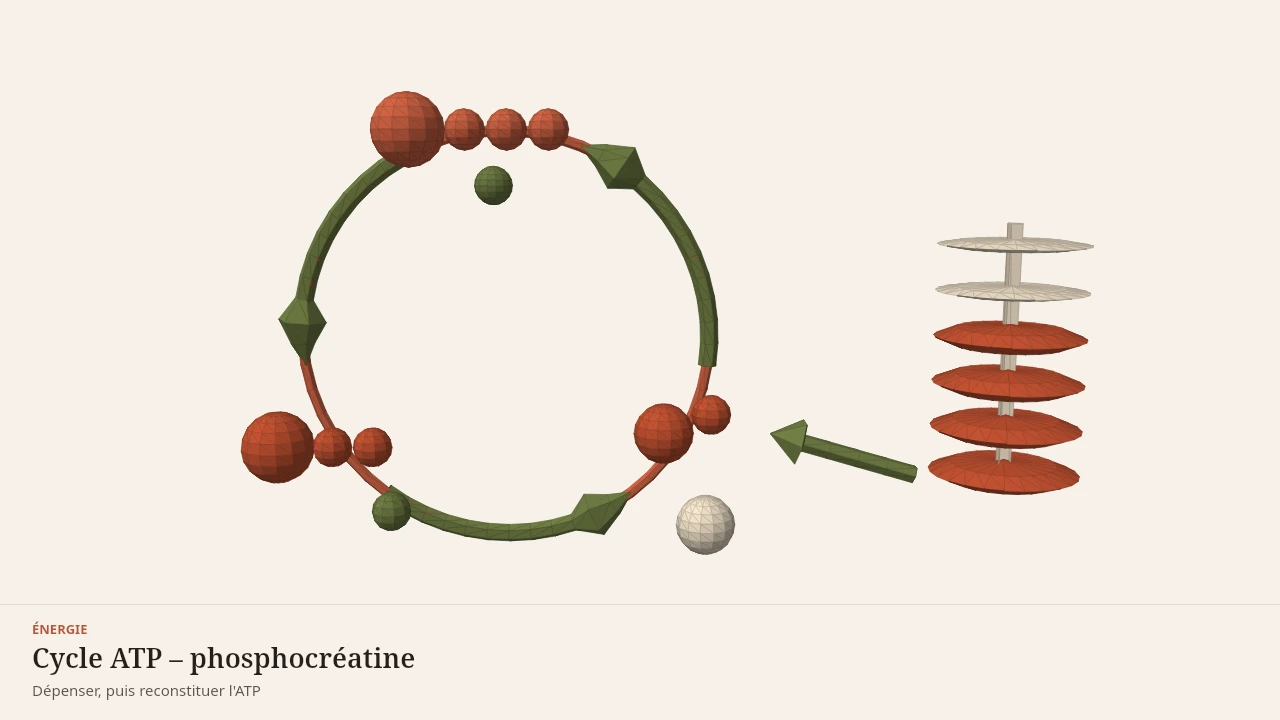
ATP–phosphocreatine cycle
The scene shows the loop that rebuilds ATP. The peripheral fatigue of the first seconds reads directly there: the immediate store empties faster than it is remade. Without the 3D, the idea fits in one sentence: it is not ATP that runs short, it is the time to rebuild it.
Current step
1. A loop, not a line
Cellular energy runs in a closed loop: ATP is spent, then rebuilt. A muscle stores almost no ATP in advance; it recycles it continuously.
Scene description
Circular diagram: a pale ring carries three stations linked by arrows running anticlockwise. At the top, ATP is drawn as a large adenosine sphere followed by three small phosphate spheres; at the bottom left, ADP carries only two of them and a detached phosphate floats alongside; at the bottom right, phosphocreatine hands over its phosphate and leaves a creatine sphere behind. To the right of the circle, six discs stacked on a spindle represent the phosphocreatine store: the four thick discs at the bottom are still available, the two thin discs at the top have already been used, and an arrow links the store to the resynthesis station. A small marker travels around the ring to follow the cycle. The volumes are symbolic: neither the shape nor the size of the molecules is depicted.
Visible structures
- ATPAdenosine triphosphate carries three phosphate groups. It is the form of energy a muscle fibre uses directly in order to contract.
- ADP and free phosphateWhen ATP gives up a phosphate, ADP and a free phosphate are left behind and the energy of the bond becomes available. The cell then has to rebuild ATP.
- PhosphocreatinePhosphocreatine stored in the muscle hands its phosphate to ADP, which rebuilds ATP almost immediately. What remains is creatine.
- Phosphocreatine storeThe stack stands for a limited store: the solid discs are still available, the pale ones have already been used. It is rebuilt during recovery.
- CreatineOnce its phosphate has been handed over, creatine is what remains. It is phosphorylated again when the effort stops and energy becomes available.
Guided steps
- 1/5Cellular energy runs in a closed loop: ATP is spent, then rebuilt. A muscle stores almost no ATP in advance; it recycles it continuously.
- 2/5ATP carries three phosphates, shown here as three small spheres in a row. It is the only form of energy the contractile proteins can use directly.
- 3/5By releasing its third phosphate, ATP becomes ADP and frees the energy that powers contraction. The detached phosphate stays available inside the cell.
- 4/5Phosphocreatine transfers its phosphate to ADP: ATP is rebuilt almost instantly, without oxygen. It is the fastest route a muscle has.
- 5/5The stack of discs stands for the phosphocreatine store: it supports a very short, very intense effort, then runs down. It is rebuilt during recovery, once the other pathways take over.
Model licence · Shapier — Propriétaire — usage interne ShapierLab
What this page does not say
Limit
An analytic frame, not a boundary
The split between central and peripheral fatigue is a descriptive tool. Both coexist in any real effort, influence each other, and their relative share is inferred from indirect measurements whose interpretation remains debated. This page's certainty level reflects that state.
Laboratory protocols often isolate one muscle. A real effort mobilises several, with cardiac and respiratory contributions those setups do not reproduce.
Finally, fatigue that persists at rest, that settles in without effort, or that comes with other signs is not what this page describes: it belongs to a health professional.
Sources
Main sources
- Gastin PB (2001). Energy system interaction and relative contribution during maximal exercise. Sports Medicine.DOI : 10.2165/00007256-200131100-00003
- Baker JS, McCormick MC, Robergs RA (2010). Interaction among skeletal muscle metabolic energy systems during intense exercise. Journal of Nutrition and Metabolism.DOI : 10.1155/2010/905612
- Fullagar HHK, Skorski S, Duffield R, Hammes D, Coutts AJ, Meyer T (2015). Sleep and athletic performance: the effects of sleep loss on exercise performance, and physiological and cognitive responses to exercise. Sports Medicine.DOI : 10.1007/s40279-014-0260-0
Put it into practice in Shapier
Plan deload weeks in Shapier
Scheduling lighter weeks so fatigue can settle is done in Shapier; Body Lab only explains what this fatigue covers.
Plan deload weeks in Shapier
Body Lab explains; Shapier lets you act and track.
Check my understanding
What does this page say about the link between the sense of effort and the drop in force?
They do not necessarily coincide: the same sense of exhaustion can come with very different drops in force.
The sense of effort faithfully measures the capacity the muscle has lost.
A strong sense of effort predicts a strong adaptation to come.
Is the split between central and peripheral fatigue a sharp boundary?
No: it is a useful analytic frame, and the two coexist and influence each other in any real effort.
Yes: a given fatigue is either central or peripheral.
No, because in reality only peripheral fatigue exists.
How is central fatigue demonstrated?
By comparing the force of a maximal voluntary contraction with the force obtained when electrical stimulation is added: if force rises, the voluntary command was not using everything still available.
By asking the person to rate their sense of effort.
By measuring the depletion of phosphocreatine stores.
Choose an answer
Read next
- Mechanical tension, fatigue and volumeShould you lift heavy, train to exhaustion, or simply do a lot? This page untangles three variables that are often confused, shows how they combine over the course of a set, and states the level of evidence behind each one.With a 3D scene
- Sleep and recoveryWhat does sleep actually do for recovery? This page describes the architecture of a night, what sleep deprivation changes in a documented way, and clearly separates established results from hypotheses that are still open.With a 3D scene
- Delayed muscle sorenessThe ache that arrives the next day is not lactic acid. What is known about where it comes from, how it runs its course, and why it measures neither the quality nor the value of a session.With a 3D scene
Available offline
Offline download is available in the mobile app.
Trust and method
Author
Editorial review
Thanh Chau
Published on
August 2, 2026
Reviewed on August 2, 2026
Next review due August 2, 2027
Limits of this page
- The split between central and peripheral fatigue is a useful analytic frame, not a sharp boundary: the two coexist and influence each other.
- The share of each in a given effort is inferred from indirect measurements — nerve stimulation, comparing voluntary and evoked force — whose interpretation remains debated.
- Laboratory protocols often isolate one muscle: transferring them to a real effort, where several groups work together, remains approximate.
- This page describes a general mechanism. Fatigue that persists at rest, that settles in without effort, or that comes with other signs belongs to a health professional.
Educational content. Body Lab does not diagnose and does not replace professional advice.
How we work