Does contracting always mean shortening?
Contracting a muscle does not always mean shortening it. An active muscle pulls on both its ends; against a load, it can shorten in a concentric regime, lengthen in an eccentric regime or hold its length in an isometric regime. The outcome depends on the relationship between the force produced and the load, not on activation alone.
Contraction regime
The relationship between the force a muscle produces and the load it faces. It determines whether the muscle shortens, lengthens or keeps its length while working.
mode of contraction
What are the three contraction regimes?
What the muscle does in each regime
Regime
Muscle length
What happens
Example in this corpus
Concentric
Decreases
The muscle's force beats the load
The rise of the squat
Eccentric
Increases
The load wins, the muscle brakes
The descent of the squat
Isometric
Unchanged
Force and load balance out
The loaded carry
The eccentric regime is the least intuitive of the three. The muscle is active, it is producing force, and yet it lengthens: it does not produce the movement, it holds it back. Walking down stairs, lowering a load to the ground, running downhill — in all these cases the muscles are the same as in the opposite movement, but employed to brake.
The isometric regime produces no visible displacement, which is why it is often underrated. The loaded carry page describes a whole movement built on it: nothing moves between hand and load, and yet fatigue sets in.
Why can a muscle produce more force while lengthening?
This is the central point of the page, and it is solidly established.
Certainty level · Established
A muscle produces more force while lengthening under tension than while shortening, and more in isometry than while shortening.
The relationship between force and shortening velocity has been measured for decades on isolated muscle and on single joints. The ranking of the three regimes depends on neither the species nor the muscle studied; the exact values do vary with the imposed speed, the muscle length and the measurement method.
Neumann DA (2016) · Herzog W (2014)
The practical consequence follows on its own: you can hold a load you cannot lift. This is neither an anomaly nor a sign of poor execution, it is a mechanical property of muscle.
It also explains an observation the muscle soreness page describes without explaining: delayed soreness follows braked efforts above all. A muscle holding back produces more force across fewer active fibres, and the stress per fibre rises.
Why, exactly?
Here certainty drops, and this page says so rather than asserting.
Certainty level · Uncertain
The extra force observed during and after active lengthening is not predicted by the classical theory of actin–myosin cross-bridges.
A mechanism has been proposed involving titin — a giant elastic protein said to span the sarcomere, whose resistance would increase on activation. The review presents it as a hypothesis consistent with the observations, not as an established fact. Other explanations remain in competition.
Herzog W (2014)
In other words: the effect is measured and reproducible, its explanation is not yet. The distinction is worth holding, because popular accounts often present titin as settled.
What eccentric training produces
Certainty level · Probable
Training that favours the eccentric regime produces gains in strength and changes in the architecture of muscle and tendon, with an effect largely specific to the mode of exercise used.
The systematic review gathers around forty studies. Specificity to the mode of exercise is its main caveat: what is gained in one eccentric protocol is not recovered in full in another regime, nor in a different movement. Protocols differ considerably between studies, and Body Lab draws no instruction from them.
Douglas J, Pearson S, Ross A, McGuigan M (2017)
A movement is not a regime
Limit
Three categories for a continuum
The three regimes are cases, not boxes. In a real movement a muscle passes from one to another continuously, and several muscles of the same group are not in the same regime at the same moment.
The squat shows this well: the descent is described as eccentric and the rise as concentric, but between the two lies an isometric instant, and the trunk muscles stay isometric throughout the movement.
The measurements underpinning this page use imposed speeds at controlled angles. They describe a property of muscle, not the distribution of regimes within an exercise.
Seeing the braked phase
The coordinated descent
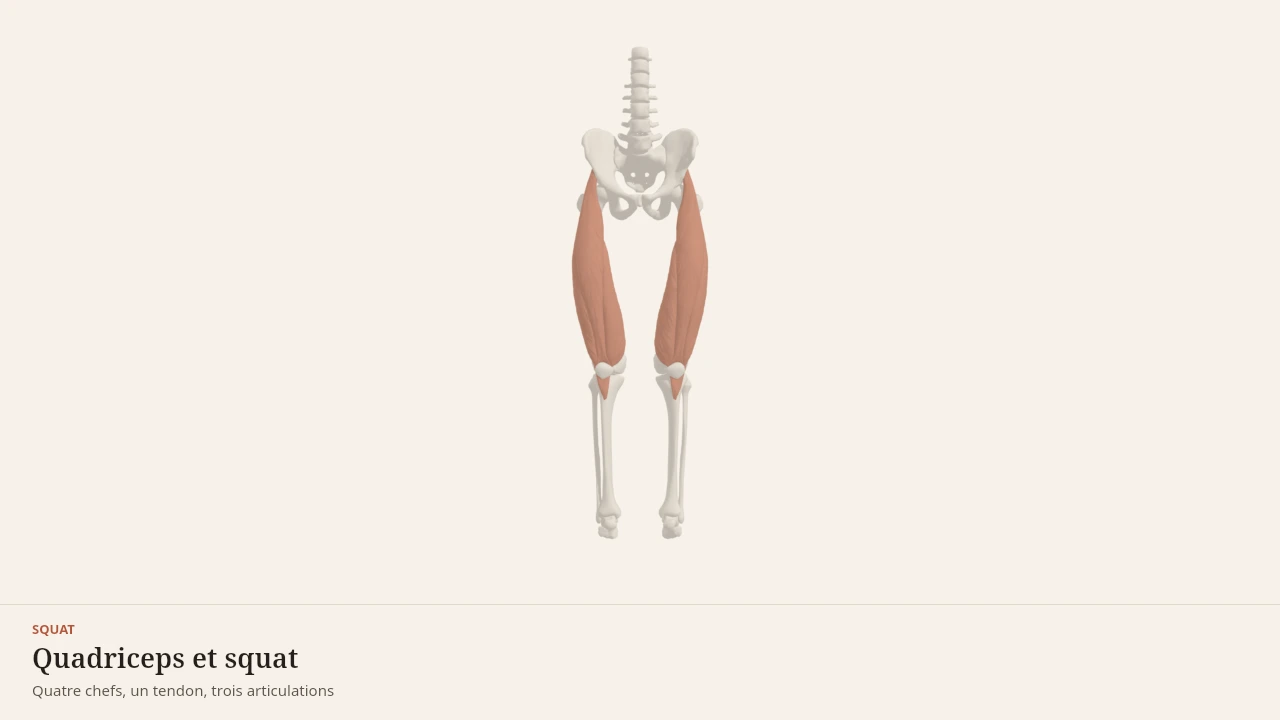
The scene shows the phase where hip, knee and ankle flex together. Without the 3D, the essential fits in one sentence: the muscles that will produce the rise are already active during the descent, but there they lengthen instead of shortening.
Current step
The coordinated descent
Ankle, knee and hip flex together. The ankle lets the knee travel forward over the foot, the femur tips backwards, and the trunk leans to keep balance over the midfoot. The quadriceps first brakes the descent, then drives the way back up.
Scene description
A three-dimensional diagram of the lower half of the body, standing, seen from the front: pelvis, femurs, tibias and patellae are shown in bone tones, with the feet and a reference trunk in a neutral paper shade. On each thigh the four heads of the quadriceps are laid over in terracotta and stay distinct: rectus femoris in the middle, vastus lateralis on the outside, vastus medialis on the inside, and the deeper vastus intermedius against the femur. Behind, the glutes cap the pelvis and the calves fill the upper shank. A three-second animation flexes the ankle, knee and hip together: the knee travels forward over the foot, the hip moves back and down, the trunk leans, and then the movement reverses. The volumes are stylised: this is a teaching diagram, not an exact anatomical reconstruction.
Visible structures
- Rectus femorisThe only head of the quadriceps to cross two joints: it arises from the anterior inferior iliac spine of the pelvis and runs down the middle of the thigh into the quadriceps tendon. It extends the knee and flexes the hip.
- Vastus lateralisThe largest of the four heads, arising from the greater trochanter and the linea aspera on the outer side of the femur. It acts on the knee alone, extending it, and gives the thigh its outer contour.
- Vastus medialisThe inner head, arising from the linea aspera of the femur, whose lowest fibres reach the patella almost horizontally. It extends the knee and helps keep the patella tracking in line.
- Vastus intermediusThe deep head, pressed against the front of the femur and covered by the other three. Invisible from the outside, it still produces a substantial share of knee extension.
- PatellaA sesamoid bone embedded in the quadriceps tendon, which continues as the patellar tendon onto the tibial tuberosity. By holding the tendon away from the knee axis, it increases the lever arm of the quadriceps.
- GlutesArising from the iliac wing and the sacrum, inserting on the femur and the iliotibial tract. In the squat they extend the hip: the more the trunk leans forward, the larger their share of the work compared with the quadriceps.
- CalvesThe gastrocnemius and soleus, joining on the calcaneus through the Achilles tendon. In the squat they work mostly as brakes, controlling ankle dorsiflexion and therefore how far the knee travels forward.
Guided steps
- 1/5The squat is not a thigh movement: it is a sequence. Pelvis, femur and tibia form three segments linked by the hip, the knee and the ankle, with the patella sitting in front of the knee. The whole mechanics of the movement lives in those pivots.
- 2/5Rectus femoris occupies the middle of the thigh, vastus lateralis its outer border, vastus medialis its inner border, and vastus intermedius hides beneath them against the femur. All four converge on a single tendon: they pull together, but only rectus femoris also crosses the hip.
- 3/5The quadriceps tendon wraps around the patella and continues to the tibial tuberosity. By holding the tendon away from the axis of flexion, the patella lengthens the lever arm — that is what makes knee extension effective in the bottom position.
- 4/5Ankle, knee and hip flex together. The ankle lets the knee travel forward over the foot, the femur tips backwards, and the trunk leans to keep balance over the midfoot. The quadriceps first brakes the descent, then drives the way back up.
- 5/5The glutes extend the hip and take on more work the further the trunk leans; the calves restrain the ankle and steady the base. The quadriceps is the most heavily loaded engine in the squat, but it does not decide the depth reached on its own.
Model licence · Z-Anatomy et BodyParts3D — CC-BY-SA 4.0
What this page does not do
Caution
No tempo, no protocol
Body Lab describes mechanisms. It gives no execution speed, no split between regimes and no protocol: that would be personalised advice, and the literature cited would not support it anyway.
The eccentric regime is used in rehabilitation within precise settings, under supervision. This page describes a property of muscle and transfers nothing to an individual situation.
Sources
Main sources
- Neumann DA (2016). Kinesiology of the Musculoskeletal System: Foundations for Rehabilitation, 3rd edition. Elsevier.https://shop.elsevier.com/books/kinesiology-of-the-musculoskeletal-system/neumann/978-0-323-28753-1
- Herzog W (2014). Mechanisms of enhanced force production in lengthening (eccentric) muscle contractions. Journal of Applied Physiology.DOI : 10.1152/japplphysiol.00069.2013
- Douglas J, Pearson S, Ross A, McGuigan M (2017). Chronic adaptations to eccentric training: a systematic review. Sports Medicine.DOI : 10.1007/s40279-016-0628-4
Put it into practice in Shapier
Structuring training for strength or hypertrophy
Steering training toward strength or hypertrophy happens in Shapier; Body Lab only explains why a muscle produces more force while lengthening than while shortening.
Structuring training for strength or hypertrophy
Body Lab explains; Shapier lets you act and track.
Check my understanding
When a muscle produces force, what happens to its length?
It can shorten, lengthen or stay the same, depending on how its force matches the load
It always shortens, since contracting means shortening
It always lengthens when the load is heavy
In which regime does a muscle produce the most force?
While lengthening under tension, i.e. in the eccentric regime
While shortening, i.e. in the concentric regime
In isometry, since nothing moves
What is known about titin's role in the extra force during lengthening?
It is a hypothesis consistent with the observations, not an established fact
It is the proven mechanism of this extra force
Nothing, because the extra force itself has not been measured
Choose an answer
Read next
- Muscle fibresA muscle is not made of one kind of fibre. Two broad families sit side by side, one slow and fatigue-resistant, the other fast and quickly tired — and their proportion is not a choice.With a 3D scene
- Delayed muscle sorenessThe ache that arrives the next day is not lactic acid. What is known about where it comes from, how it runs its course, and why it measures neither the quality nor the value of a session.With a 3D scene
- SquatThe squat is a simultaneous flexion, then extension, of the hips, knees and ankles with the feet planted on the ground. This page describes its phases, the joints involved, the muscles that contribute and the most widespread misconceptions about it.With a 3D scene
Where to go next
- How muscle growsWhat actually makes a muscle grow? This page follows the chain of events that links a set of exercise to a thicker muscle fibre, and separates what is established from what is still debated by research.
Available offline
Offline download is available in the mobile app.
Trust and method
Author
Editorial review
Thanh Chau
Published on
August 2, 2026
Reviewed on August 2, 2026
Next review due August 2, 2027
Limits of this page
- The relationship between force and velocity is measured on isolated muscle or a single joint, at imposed speeds. A real movement runs through all three regimes continuously and does not reduce to them.
- The mechanism proposed for the extra force during lengthening is debated: classical theories of contraction do not predict it.
- Conclusions about eccentric training depend heavily on the protocol used, and transfer poorly from one mode of work to another.
- This page proposes no tempo, no protocol and no split between regimes: that would be personalised advice.
Educational content. Body Lab does not diagnose and does not replace professional advice.
How we work