The stores that fuel a sprint empty within tens of seconds. What takes over is slower, but its capacity is on another scale entirely — and that pathway never stops, not even during the sprint.
Where lasting energy comes from
Duration: 1:18
Chapters
Transcript
The stores that fuel a sprint empty within tens of seconds. Past that point, most of the energy comes from a slower pathway whose capacity is on another scale entirely.
Muscle glycogen is a real but limited store, on the order of a few thousand kilojoules. It is rebuilt after effort, along with the water that comes with it. Fat forms a far larger store, but one that is slower to mobilise.
ATP is barely stored: it is rebuilt continuously, as fast as it is spent. The aerobic system keeps that recycling running by oxidising carbohydrate and fat inside the mitochondria, and it runs all the time — including at rest and during a sprint.
At low intensity, fat supplies a large share of the energy; at high intensity, carbohydrate takes over. What changes is never whether a pathway is switched on, only its relative contribution. And a higher share of fat says nothing about total energy spent: the two ideas are often conflated.
What the video shows
The central shot is not a store but a loop, and that is deliberate. The hardest idea to get across on this subject is that ATP is barely stored at all: it is rebuilt continuously, as fast as it is spent.
Oxidation
A reaction that removes electrons from a molecule. In muscle, oxidising a fuel means recovering its energy in usable form, gradually turning it into carbon dioxide and water.
cellular combustion
The aerobic system keeps that recycling running, inside the mitochondria, by oxidising carbohydrate and fat with oxygen. It yields far more ATP per molecule of fuel than the fast pathways, but it yields it more slowly.
Certainty level · Established
The aerobic system becomes the dominant source of ATP as soon as an effort passes a few tens of seconds.
Reviews of energy system interaction converge on this point, drawing on gas exchange and biopsies during maximal ergometer efforts. The exact timing of the shift varies with the estimation method and the protocol used.
Gastin PB (2001) · Baker JS, McCormick MC, Robergs RA (2010)
Two fuels, a gradual shift
At low intensity, fat supplies a large part of the energy. As intensity rises, the share of carbohydrate grows until it dominates. The reason is mechanical: making ATP from fat takes more oxygen and more steps, which caps the rate.
What the video insists on showing is that no pathway switches off. What changes with intensity is the relative contribution of each, never whether it is running.
Certainty level · Probable
Carbohydrate availability limits performance in prolonged efforts of sustained intensity.
Reviews on carbohydrate for training describe a drop in pace associated with depletion of [glycogen](/en/energy/muscle-glycogen-and-water). The size of the effect depends on duration, intensity, food intake before the effort and training status.
Burke LM, Hawley JA, Wong SHS, Jeukendrup AE (2011)
A common confusion
Caution
Share of fat and total energy
The share of fat is higher at low intensity. That is correct, and it says nothing about the total energy spent, which is lower at that intensity.
The two ideas — proportion and quantity — are regularly conflated, and the confusion often serves as an argument. This page describes a mechanism; it prescribes no way of training.
ATP–phosphocreatine cycle
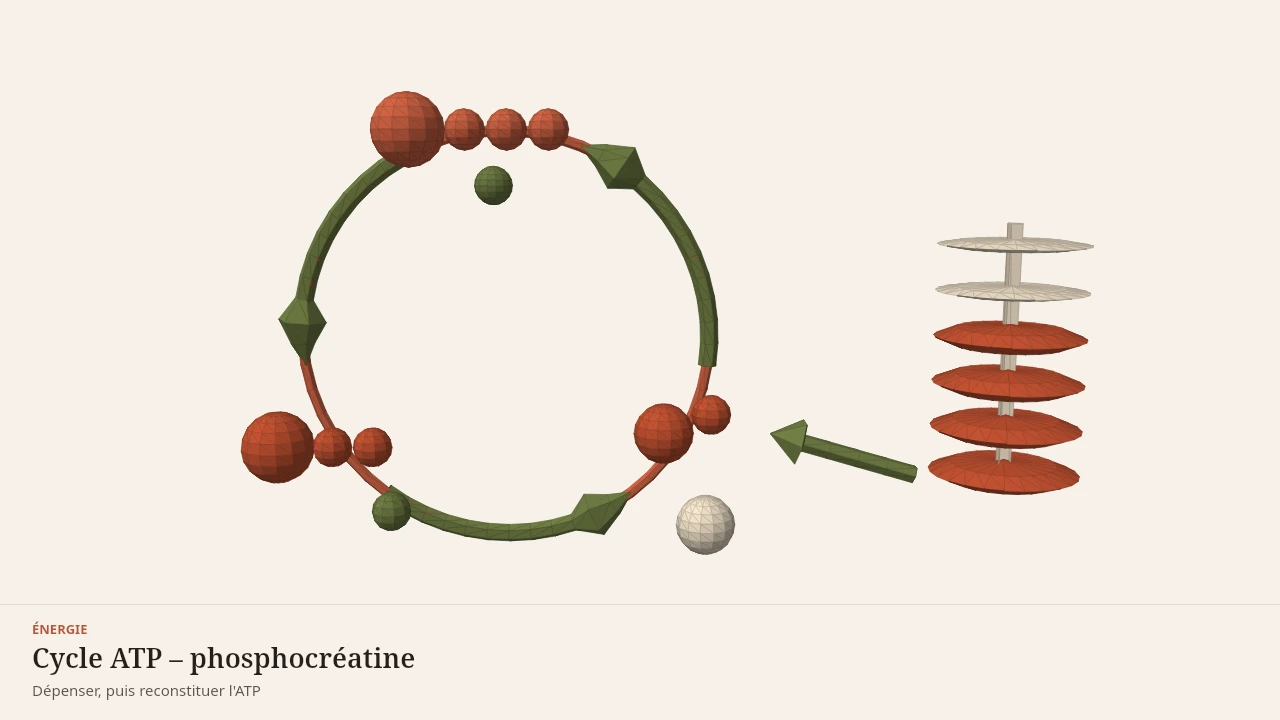
The scene shows the same loop in three dimensions. The aerobic pathway is what feeds it continuously: ATP is not stored but recycled, and the aerobic system keeps the recycling running.
Current step
1. A loop, not a line
Cellular energy runs in a closed loop: ATP is spent, then rebuilt. A muscle stores almost no ATP in advance; it recycles it continuously.
Scene description
Circular diagram: a pale ring carries three stations linked by arrows running anticlockwise. At the top, ATP is drawn as a large adenosine sphere followed by three small phosphate spheres; at the bottom left, ADP carries only two of them and a detached phosphate floats alongside; at the bottom right, phosphocreatine hands over its phosphate and leaves a creatine sphere behind. To the right of the circle, six discs stacked on a spindle represent the phosphocreatine store: the four thick discs at the bottom are still available, the two thin discs at the top have already been used, and an arrow links the store to the resynthesis station. A small marker travels around the ring to follow the cycle. The volumes are symbolic: neither the shape nor the size of the molecules is depicted.
Visible structures
- ATPAdenosine triphosphate carries three phosphate groups. It is the form of energy a muscle fibre uses directly in order to contract.
- ADP and free phosphateWhen ATP gives up a phosphate, ADP and a free phosphate are left behind and the energy of the bond becomes available. The cell then has to rebuild ATP.
- PhosphocreatinePhosphocreatine stored in the muscle hands its phosphate to ADP, which rebuilds ATP almost immediately. What remains is creatine.
- Phosphocreatine storeThe stack stands for a limited store: the solid discs are still available, the pale ones have already been used. It is rebuilt during recovery.
- CreatineOnce its phosphate has been handed over, creatine is what remains. It is phosphorylated again when the effort stops and energy becomes available.
Guided steps
- 1/5Cellular energy runs in a closed loop: ATP is spent, then rebuilt. A muscle stores almost no ATP in advance; it recycles it continuously.
- 2/5ATP carries three phosphates, shown here as three small spheres in a row. It is the only form of energy the contractile proteins can use directly.
- 3/5By releasing its third phosphate, ATP becomes ADP and frees the energy that powers contraction. The detached phosphate stays available inside the cell.
- 4/5Phosphocreatine transfers its phosphate to ADP: ATP is rebuilt almost instantly, without oxygen. It is the fastest route a muscle has.
- 5/5The stack of discs stands for the phosphocreatine store: it supports a very short, very intense effort, then runs down. It is rebuilt during recovery, once the other pathways take over.
Model licence · Shapier — Propriétaire — usage interne ShapierLab
Sources
Main sources
- Gastin PB (2001). Energy system interaction and relative contribution during maximal exercise. Sports Medicine.DOI : 10.2165/00007256-200131100-00003
- Baker JS, McCormick MC, Robergs RA (2010). Interaction among skeletal muscle metabolic energy systems during intense exercise. Journal of Nutrition and Metabolism.DOI : 10.1155/2010/905612
- Burke LM, Hawley JA, Wong SHS, Jeukendrup AE (2011). Carbohydrates for training and competition. Journal of Sports Sciences.DOI : 10.1080/02640414.2011.585473
Put it into practice in Shapier
See a carbohydrate source in Shapier
Open the Shapier sheet for a common carbohydrate source.
See a carbohydrate source in Shapier
Body Lab explains; Shapier lets you act and track.
Check my understanding
What is known about ATP storage in muscle?
It is minimal: ATP is rebuilt continuously, as fast as it is spent
It is stored in large reserves that empty during exercise
It is stored inside the mitochondria between efforts
As exercise intensity rises, what happens to the energy pathways?
They all keep running: only their relative contribution changes
The fat pathway stops once carbohydrate becomes dominant
The aerobic system only starts after a few tens of seconds
The share of fat is higher at low intensity: which conclusion is correct?
None about total energy: total expenditure is lower at low intensity, and proportion and quantity are different things
More fat is burned in absolute terms at low intensity
The share of carbohydrate also rises at low intensity
Choose an answer
Read next
- The aerobic systemThe pathway that supplies most of the energy as soon as an effort lasts. It burns carbohydrate and fat with oxygen, produces a great deal but slowly, and never switches off.With a 3D scene
- Hydration and performanceWater is not a side note to effort. It carries the blood, carries heat away and accompanies glycogen storage: three roles that explain what losing water changes.With a 3D scene
- What becomes of what you eatEight steps following protein, carbohydrate, fat and water from the meal to the muscle. A pathway of mechanisms, with no amounts, no recommended foods and no timing.Described without a scene
Available offline
Offline download is available in the mobile app.
Trust and method
Author
Editorial review
Thanh Chau
Published on
August 2, 2026
Reviewed on August 2, 2026
Next review due August 2, 2027
Limits of this page
- The bars comparing fat and carbohydrate convey a trend, not a measurement: the real proportion depends on intensity, duration, recent food intake and training.
- The available measurements rely on gas exchange and biopsies taken in laboratories, on small numbers of people, under conditions more controlled than real training.
- The video describes a general mechanism: it assesses no one's fitness and proposes no diet.
Educational content. Body Lab does not diagnose and does not replace professional advice.
How we work