What becomes of a carbohydrate once eaten?
The muscle glycogen page describes a store: what it holds, what it weighs and how it empties. This one starts where that page begins. Between the plate and the muscle fibre lie several steps, and most misunderstandings live inside those steps.
Key point
The answer in three sentences
A dietary carbohydrate is taken apart in the gut into simple sugars, absorbed, then carried by the blood to the liver. From there it is sorted: burnt on the spot, put into store in the liver, or sent on to muscle, which stores it in turn.
Both stores carry the same name — glycogen — but they do not render the same service, and one cannot stand in for the other.
From the meal to the blood
Simple sugar
The smallest unit of a carbohydrate, which digestion cannot break down further. Only three leave the intestine in quantity: glucose, fructose and galactose.
monosaccharide
Digestion begins in the mouth and continues mainly in the small intestine, where enzymes cut long chains — starch, compound sugars — into single units. Those units cross the intestinal wall through specialised transporters, different ones for different sugars, and then join the portal vein.
That vein leads to the liver before any other destination. No absorbed carbohydrate reaches muscle without passing through this organ, which takes a share and lets the rest go on.
Certainty level · Established
The absorption rate of a given carbohydrate is capped by the number of intestinal transporters able to handle it; recruiting several transport routes partly lifts that limit.
The finding comes from work on carbohydrate use during prolonged endurance efforts, in trained subjects. It concerns measured rates of use, not a benefit for body composition or for resistance training.
Jeukendrup AE (2010)
The sorting, and its three destinations
Once in the circulation, sugar does not go to a single place. It is distributed according to what the body needs at that moment.
- Burnt straight away. The brain, the red blood cells and every active tissue consume glucose continuously. This is the most immediate destination, and the only one requiring no store.
- Put into store in the liver. The liver assembles part of the glucose into glycogen, which it can cut up again and release into the blood.
- Put into store in the muscle. Muscle does the same, but for its exclusive use — this is the store described on the muscle glycogen page.
Two stores carrying the same name
This is the most useful distinction on the page, and the one most often missed.
The liver holds the enzyme that releases glucose into the blood from its glycogen. Muscle does not. What a muscle fibre has stored, it keeps: muscle glycogen never feeds blood sugar nor other muscles, it serves only the fibre that contains it.
Liver glycogen and muscle glycogen
Criterion
Liver store
Muscle store
Recipient
The whole body, through the blood
Only the fibre that holds it
Main role
Maintain blood glucose
Fuel contraction
Release into the blood
Possible
Not possible
Total amount
Smaller
Larger, spread through the body
Certainty level · Established
Liver glycogen contributes to maintaining blood glucose, whereas muscle glycogen is used locally by the fibre that stores it.
This functional separation underpins the work on carbohydrate availability for training, measured by muscle biopsy and by tracers. The amounts stored on either side vary with diet, with training and with when the measurement is taken, and no single value holds for everyone.
Burke LM, Hawley JA, Wong SHS, Jeukendrup AE (2011)
Seeing the end of the journey
Refuelling the muscle store
The scene shows the last stage of the journey described here: glucose arriving through the blood is reassembled into granules inside the fibre. Without the 3D, the picture fits in one sentence: the store refills the way it emptied, and the water that goes with it comes back too.
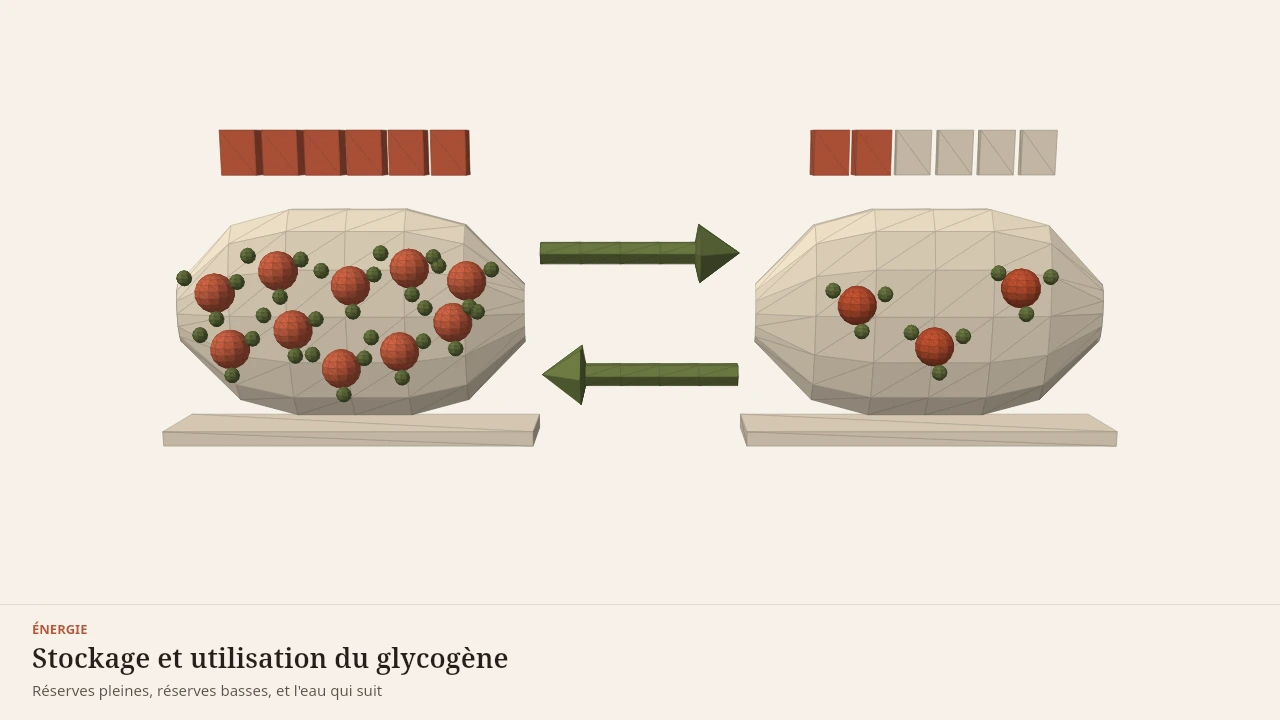
Current step
5. Refuelling
Dietary carbohydrate rebuilds the store and the water returns with it: the lower arrow brings the fibre back to its full state. This back-and-forth repeats continuously, independently of fat mass.
Scene description
Comparative diagram: two identical muscle fibres, opened lengthwise like slices, sit side by side on pale plinths. The left one, with full stores, holds about ten dark spheres — the glycogen granules — each ringed by three small spheres standing for the water stored with it; above it, a six-segment gauge is completely filled. The right one, with low stores, holds only three granules and their water, and its gauge shows just two solid segments followed by four hollow ones. Between the two fibres, an upper arrow pointing right represents the effort that empties the store, and a lower arrow pointing left represents the dietary refuelling that rebuilds it. Sizes and counts are symbolic: nothing here is to scale.
Visible structures
- Glycogen granuleGlycogen is the form in which muscle stores carbohydrate. It is gathered into granules spread through the fibre, ready to be mobilised quickly during effort.
- Associated waterGlycogen is stored together with water, shown here as the small satellite spheres. When the store falls, that water leaves with it and the number on the scale follows, which says nothing about fat mass.
- Fibre in sectionThe fibre is drawn as a slice, as if it had been opened along its length. The section only serves to show what it contains.
- Low storesAfter a long effort, few granules are left. The fibre still works, but the intensity it can sustain drops.
- RefuellingDietary carbohydrate rebuilds glycogen, and the associated water comes back with it. This is one of the reasons the number on the scale moves from one day to the next.
Guided steps
- 1/5On the left, a muscle fibre opened along its length. The dark spheres spread inside stand for glycogen granules, the form in which muscle stores carbohydrate.
- 2/5Each granule is ringed by small spheres: the water stored alongside it. Glycogen and water travel together, which explains part of the day-to-day swings on the scale.
- 3/5During sustained effort the fibre breaks down its glycogen to produce energy. The upper arrow shows the move from one state to the other, and the group of granules shrinks.
- 4/5On the right, the same fibre after the effort: few granules, little associated water, an almost empty gauge. The number on the scale has dropped, but that particular drop comes from glycogen and its water, not from fat mass.
- 5/5Dietary carbohydrate rebuilds the store and the water returns with it: the lower arrow brings the fibre back to its full state. This back-and-forth repeats continuously, independently of fat mass.
Model licence · Shapier — Propriétaire — usage interne ShapierLab
What the glycaemic index measures
Ranking foods by their effect on blood sugar is probably the most widely spread notion on the subject, and the one most often stretched beyond what it establishes.
Certainty level · Established
Foods containing the same amount of carbohydrate produce markedly different rises in blood glucose, which allows them to be ranked against one another.
The original measurement covers sixty-two foods, given on their own to fasted volunteers in groups of five to ten, with blood glucose followed for two hours. It describes the response to a single food, under laboratory conditions.
Jenkins DJA, Wolever TMS, Taylor RH, Barker H, Fielden H, Baldwin JM, Bowling AC, Newman HC, Jenkins AL, Goff DV (1981)
Caution
Three common slips
From a single food to a meal. The index is measured on one food given alone, fasted. A full meal mixes fibre, fat and protein, which change the response.
From a blood sugar response to a fate. The ranking describes how fast glucose appears in the blood. It says nothing about where it goes next, nor about body composition.
From a group average to a person. Published values are averages over small samples. The variability between individuals, and within one individual from one day to the next, is real.
What this page does not do
Limit
No quantity, no food, no timing
Body Lab describes mechanisms. It recommends no amount of carbohydrate, ranks no food as good or bad and proposes no timing: that would be personalised advice.
Needs vary with body mass, activity, health status and the diet followed. A question about a blood sugar level, diabetes, a particular diet or an intolerance belongs to a health professional, who has the context a page does not.
Sources
Main sources
- Burke LM, Hawley JA, Wong SHS, Jeukendrup AE (2011). Carbohydrates for training and competition. Journal of Sports Sciences.DOI : 10.1080/02640414.2011.585473
- Jeukendrup AE (2010). Carbohydrate and exercise performance: the role of multiple transportable carbohydrates. Current Opinion in Clinical Nutrition and Metabolic Care.DOI : 10.1097/mco.0b013e328339de9f
- Jenkins DJA, Wolever TMS, Taylor RH, Barker H, Fielden H, Baldwin JM, Bowling AC, Newman HC, Jenkins AL, Goff DV (1981). Glycemic index of foods: a physiological basis for carbohydrate exchange. The American Journal of Clinical Nutrition.DOI : 10.1093/ajcn/34.3.362
Put it into practice in Shapier
Work out your macronutrient split
Setting the carbohydrate share of your intake is done in Shapier; Body Lab only explains what becomes of a carbohydrate once eaten.
Work out your macronutrient split
Body Lab explains; Shapier lets you act and track.
Check my understanding
Why can glycogen stored in a muscle not feed blood sugar?
Muscle does not hold the enzyme that releases glucose into the blood: its glycogen serves only the fibre that contains it.
Because muscle glycogen is first converted into fat before any release.
Because blood never reaches the muscles.
What does a food's glycaemic index measure?
How fast the glucose of a food given alone, fasted, appears in the blood.
Where the glucose ends up once absorbed.
The blood sugar response to a full meal containing that food.
What route does an absorbed carbohydrate take before it can reach muscle?
It must pass through the liver, which takes a share and lets the rest go on.
It is stored in muscle straight out of the intestine.
It is entirely burnt by the brain and the red blood cells.
Choose an answer
Read next
- Muscle glycogen and waterWhy can the number on the scales change within two days without any change in fat mass? This page explains what muscle glycogen is, its role as a fuel and the water that accompanies it inside the muscle.With a 3D scene
- What happens to dietary fatFat does not dissolve in water: its route out of the intestine resembles that of no other nutrient. It joins an enormous store, and its share during effort follows a curve that rises and then falls.Described without a scene
- The aerobic systemThe pathway that supplies most of the energy as soon as an effort lasts. It burns carbohydrate and fat with oxygen, produces a great deal but slowly, and never switches off.With a 3D scene
Available offline
Offline download is available in the mobile app.
Trust and method
Author
Editorial review
Thanh Chau
Published on
August 2, 2026
Reviewed on August 2, 2026
Next review due August 2, 2027
Limits of this page
- This page carries no quantity, no timing, no ranking of foods and no individual dietary advice.
- The work cited on carbohydrate use during exercise concerns mostly prolonged endurance efforts; transferring it to resistance training is limited.
- The glycaemic index is measured on a single food, fasted, in small groups of volunteers: it does not predict the response to a full meal nor that of a given person.
- Any question about a diet, a blood sugar level, diabetes or an intolerance belongs to a health professional.
Educational content. Body Lab does not diagnose and does not replace professional advice.
How we work